

How We Helped an Accessories Brand Grow Revenue 50L in 4 Months
4.6x
Revenue growth in 4 months
₹51.3L
Peak monthly revenue (vs ₹11.05L before)
4,657
Monthly orders at peak (vs 1,163 before)
7.39
ROAS on BOF+MOF retargeting

Context
Gear is an India-based lifestyle brand selling bags and everyday essentials across work, travel, and daily carry — premium quality at accessible price points. When Adbuffs took over in October 2025, the Meta account was generating ₹11.05L per month from 1,163 orders, heavily dependent on a small set of hero SKUs, with no creative testing pipeline and no separation between prospecting and retargeting.
The account also ran into two operational disruptions during the engagement: top-selling products going out of stock mid-campaign, and a Meta credit line issue that temporarily paused the account and reset learning phases. Both required the account structure to absorb the hit without collapsing.
Objectives
Build a revenue engine that isn’t hostage to a single product or creative. The mandate was to diversify spend across categories — work bags, travel bags, laptop bags — establish a systematic creative testing loop across static, video, carousel, and UGC formats, and grow new customer acquisition month on month.
What we did
- Multi-Category Campaign Architecture
Adbuffs rebuilt the account around four campaign types with distinct jobs: a CBO creative testing campaign, a dedicated UGC campaign, an ABO catalogue campaign split by category (Laptop Bags, Travel Bags, Work Bags), and a BOF+MOF retargeting campaign. Separating these prevented the budget from bleeding into unresolved learning phases and gave clean, category-level ROAS data.The Laptop Bags catalogue delivered a 4.10 ROAS on ₹6.44L spend with 2,236 purchases at ₹288.21 per purchase — the highest-efficiency ad set in the account. When primary SKUs went out of stock, parallel category campaigns kept spending and learning with no reset. - Lifestyle-First Creative Strategy
Creative briefs were built around four consumer personas — working professionals, frequent travellers, daily commuters, and students — rather than product specs. Each persona got distinct use-case angles across carousel, static, and UGC video formats. UGC content featured varied age groups and genders to expand audience relatability. This creative volume is what powered consistent new customer growth: 1,000 new customers in October, scaling to 4,200+ by January.
The BOF+MOF retargeting campaign closed the loop — 2,494 purchases at ₹140.89 per purchase with a 7.39 ROAS — confirming the prospecting campaigns were sending qualified traffic, not just volume.
Key Learnings
- Single-SKU dependency is a structural risk, not a performance problem
Multi-category campaign architecture needs to be built before the first stockout — it can’t be retrofitted after. - Category-level ABO produces cleaner data than blended catalogues
Laptop Bags at 4.10 ROAS would have been invisible inside a blended catalogue. Clean separation makes reallocation a data decision, not a guess. - Personas outperform product specs in the lifestyle category
Buyers don’t purchase a bag — they purchase what the bag enables in their daily routine. Creative that leads with use-case converts better than feature-first.
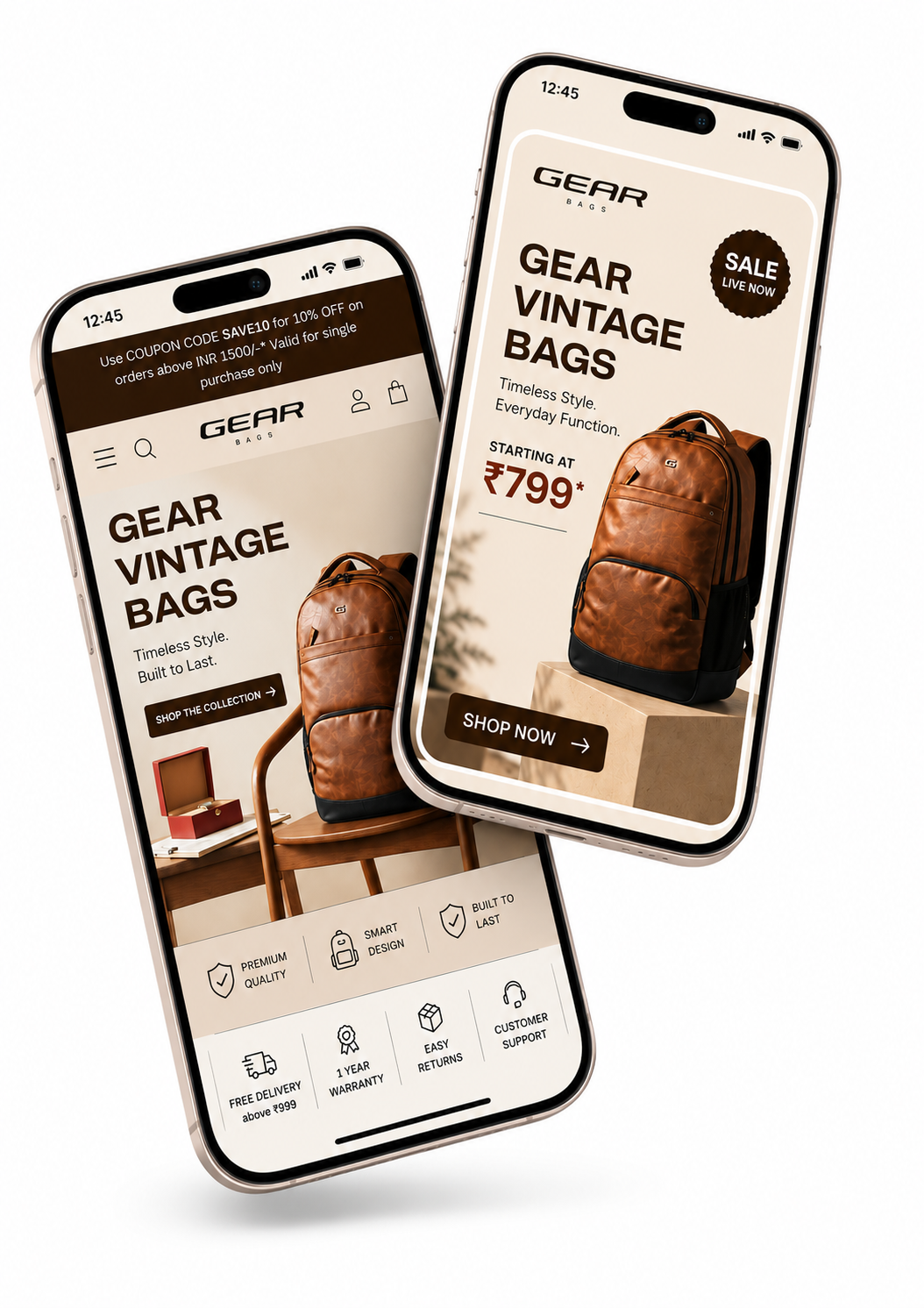
Creatives used for our Clients


Want results like these for your brand?