Adbuffs

← Blog

Meta only sees 1% of your customers

The other 99% of your business is dark to its AI: every in-store sale, every phone order, every offline purchase. Here’s what it cost one brand to stop feeding that signal back, and why we treat it as infrastructure, not attribution.
The short answer

Meta optimises on the conversions it can see. On a typical campaign only about 1% of the people it reaches click through to your site, so it makes spend decisions on a sliver of the real result. Every sale in a store, over the phone, or anywhere off your site is invisible to it.

Offline CAPI feeds those hidden conversions back, so Meta optimises toward people who actually buy, not just people who click. Once it’s running, it stops being a report and becomes part of how the algorithm delivers. Pull it out and performance degrades across the whole account, online included. That’s the difference between treating signal as attribution and treating it as infrastructure.

Every performance marketer has watched Meta’s AI get eerily good at finding buyers. Fewer have asked the question that decides whether it works for you at all: what is it actually learning from? For most brands, the answer is a rounding error.
Takeaways

The short version

01 — The problem

Where does the other 99% go?

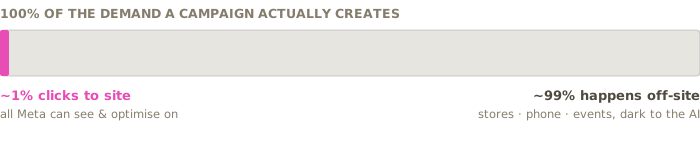
Start with a number every media buyer knows but rarely sits with: on a healthy campaign, click-through rate tops out around 1%. So of everyone Meta puts your ad in front of, about one in a hundred lands on your website. That 1% is the only group Meta gets a clean conversion signal from, because the pixel lives on your site, and the site is all it can watch.
For a pure-online brand that’s already a gap. For anyone who also sells offline, whether that’s a store, a tele-calling team closing orders, or a stall at an event, it’s a chasm. The ad does its work, the customer walks into a shop or picks up the phone a week later, and Meta records nothing. As far as its AI is concerned, that sale never happened, so it never learns to find more people like that buyer.
The cost most people miss is second-order. Meta’s AI is a feedback machine. It gets better at finding buyers as you feed it examples of buyers. Starve it of 99% of the real conversions and it doesn’t just under-report; it under-performs, because it’s learning from the wrong, thin sample. The fix isn’t a better dashboard. It’s a better signal.
If the algorithm is blind to 99% of the result, it’s optimising your budget on a rounding error.
The terms, stated plainly
Offline CAPI
Offline Conversions API. A way to send Meta the purchases that happen off your website (in a store, over the phone, at an event) so its AI can optimise toward the people who make them. Standard server-side CAPI captures on-site events; offline CAPI captures the ones the site never sees.
The 1% problem
Because click-through rate is roughly 1%, the website, and therefore Meta’s default conversion signal, represents only about 1% of the demand a campaign creates. The other 99% is invisible to the algorithm unless you feed it back.
Organic footfall fallacy
The belief that in-store or offline sales are happening on their own and ads play no incremental role. The costliest assumption an omnichannel brand can make, because it stays invisible until the ads are switched off and the “organic” revenue falls with them.
Blended ROAS
Total revenue across every channel a campaign can influence, online and offline, divided by ad spend. The only honest return figure for a brand that sells in more than one place.
Offline ROAS
Revenue from offline purchases attributed through offline CAPI, divided by spend. Cleanest to read when offline conversions are sent to a dedicated pixel, separate from online, so the offline contribution is unambiguous.
02 — The framework

Signal as infrastructure, not attribution

Most teams file conversion tracking under “measurement,” a thing you set up to see results. That framing is why offline signal gets cut first when budgets tighten: if it’s only a report, losing it feels harmless. It isn’t a report. It’s a feed into a live optimisation engine.

An Adbuffs operating principle

Signal as Infrastructure

Conversion signal is not a mirror that reflects what your ads did. It’s a nervous system that tells the algorithm what to do next. Attribution looks backward; signal acts forward. The moment Meta starts optimising on a conversion feed, that feed is load-bearing. Pull it, and the structure above it sags.
The test is simple. If switching a signal off changes nothing, it was attribution. If switching it off changes delivery (who gets served, at what cost, across channels you didn’t touch) it was infrastructure. Offline CAPI, done right, is the second kind.
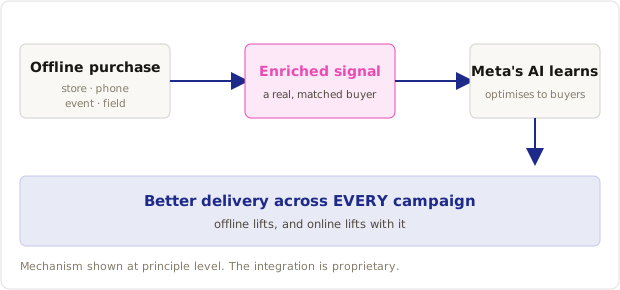
The signal flow, at the level we’ll show, looks like this. A purchase happens somewhere Meta can’t watch. We enrich it into a clean customer signal and send it back. The algorithm learns from a real buyer it would otherwise never have seen, and applies that learning to every campaign, including the online ones.
Note: we keep the exact build private. What matters is the shape: a hidden conversion becomes a learning example, and the learning spreads account-wide.
03 — The evidence

A brand turned the signal off. We got to watch.

Theory is cheap. This one we can show, because a client ran the cleanest test you can run, by accident, and against our advice.
A multi-city South Indian jewellery brand sold across four cities plus a growing online D2C channel. We ran their Meta campaigns with full offline CAPI integration, feeding in-store purchases back to the algorithm. Across the active months, offline was consistently 82–87% of total brand revenue. And running the signal didn’t just grow the stores; it lifted the online channel too.
Then leadership formed a belief: the stores were growing on their own, so the ads weren’t really doing anything offline. The online numbers looked soft and deserved full focus. So on 15 January 2026 they paused every offline-CAPI campaign and stood up a fresh pixel for online only, willingly putting the majority revenue stream (offline, ~₹300–400L a month) at risk to chase the minority one (online, ~₹50–90L a month).
What the pause revealed
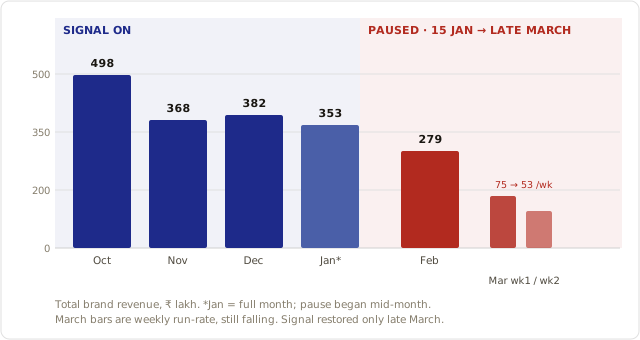
The “organic” channel did not hold. It fell off a shelf, and kept falling the whole time the signal stayed off.
Source: client account, anonymised. Dec → Feb: offline revenue −27%, brand revenue −27%. The decline carried on through most of March while the signal stayed off.
Three reads fall straight out of that chart, and they dismantle the belief that triggered the pause:
The objection I'll raise before you do
A sharp reader will notice spend also dropped over this stretch. So isn’t the revenue fall just “we spent less,” not “we pulled the signal”? Fair. I won’t dress this up as a controlled lab result, because it isn’t one. Here’s what it does and doesn’t prove.
Proven cold: the organic-footfall belief was wrong. When the ads pulled back, the supposedly self-sustaining 82% of the business fell with them, and kept falling for over two months. That conclusion needs no assumptions.
The expert read on causation: spend didn’t fall and then revenue follow. Both fell together, because a blinded account can’t absorb budget efficiently. CPA climbs, so spend bleeds down. The throttling is a symptom of signal loss, not an independent cause. The clincher a pure spend-cut story can’t explain: when the signal came back, the account became spendable and performant again. Same brand, same product, signal off then on. That arc is the closest thing to a holdout you get outside a textbook.
Switching it back on
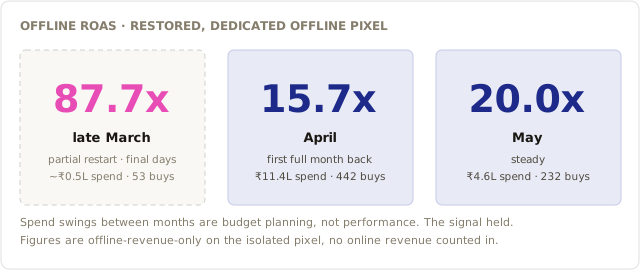
We restored offline CAPI in late March, and this time isolated it on a dedicated offline pixel, separate from the online one, so the offline contribution couldn’t be argued with. March itself was mostly lost (the signal returned only in its final days, on tiny spend). The first full months back tell the real story:
Source: client account, anonymised, restored offline pixel. ROAS here is offline revenue only, not blended.
Read it like this: the whole argument sits in one account. On, it scaled. Off, it collapsed for two-plus months. On again, it recovered. The brand had to lose the revenue to believe the signal was real. You don’t have to.

04 — The nuance

When this matters, and when it doesn't

Offline CAPI is not a universal lever. It earns its place when a meaningful share of your sales happens where the pixel can’t see: physical stores, a tele-calling or field team, events, counter sales. If you’re 100% online with on-site checkout, standard server-side CAPI already carries your signal and offline CAPI adds little.
It’s also not a trick for inflating ROAS. Sending more conversions makes your reported numbers bigger, yes. But the point isn’t the bigger number; it’s that the algorithm now learns from real buyers it was blind to. Done as attribution theatre, it flatters a dashboard. Done as infrastructure, it changes who gets served. The brand above proves which one is worth having: the version you can switch off without anything happening was never the valuable one.
And it sits inside a larger truth this series keeps circling. Reported ROAS lies about which ad caused the sale. It lies about whether the order even arrives. Here it lies by omission: it can only speak for the 1% it can see. Three faces of one problem: Meta’s optimisation is only as good as the signal you feed it, and by default that signal is dangerously incomplete.
05 — What to do with this

If you sell anywhere off your site

Three moves, in order.

Find your blind spot.

Add up the revenue that happens off-site (store, phone, events) as a share of total. If it's more than a rounding error, Meta is optimising half-blind right now.

02

Feed the conversions back, cleanly and isolated.

Get those off-site purchases to the algorithm as an enriched signal, and keep offline on its own pixel so you can read its contribution honestly.

03

Never treat the signal as optional.

Once it's feeding delivery, cutting it to "test if it matters" is the exact test the brand above ran. It cost them a quarter of their revenue, for over two months, to fail it.

The build that does this cleanly is ours, and for Adbuffs clients it’s included, not sold. There’s no separate product to buy. What we’ll say in public is the principle, because the principle is what changes how you think: the machine can only optimise toward what it can see, so your job is to make sure it can see the parts of your business that actually pay the bills.
Built in-house · included for Adbuffs clients at no extra cost
Related concepts

Where this sits in the stack

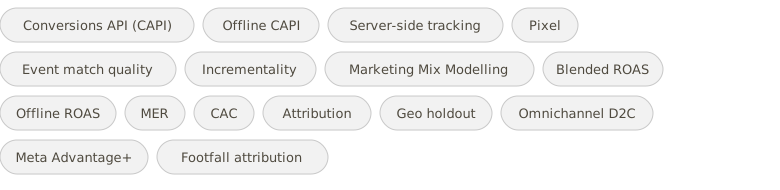
Hold these alongside it. They’re the machinery this piece plugs into:

Questions founders ask us

What is offline CAPI and how is it different from the normal pixel?
The pixel and standard server-side CAPI track conversions on your website. Offline CAPI sends Meta the conversions that happen off your site (in a store, over the phone, at an event) so its AI can optimise toward those buyers too. Same algorithm, a much more complete picture.
Roughly, for the on-site signal. Click-through rate sits around 1%, so the website that the pixel watches represents about 1% of the demand a campaign creates. For an omnichannel brand the unseen share is enormous, which is exactly why feeding it back moves performance, not just reporting.
Your reported numbers will rise because real conversions are finally counted. But the value isn’t the bigger figure; it’s that the algorithm now learns from buyers it was blind to and serves your ads better. If switching the signal off changes nothing in delivery, it was attribution theatre. If it changes who gets served, it was infrastructure.
If the algorithm has been optimising on that signal, delivery degrades across the whole account, including online campaigns you didn’t touch. One brand paused it believing in-store sales were organic; brand revenue fell about 27% and kept falling for over two months, recovering only when the signal was restored.
It’s strongest there, but not limited to it. Any brand closing sales off-site (a tele-calling team, COD confirmed by phone, field or event sales) has the same blind spot. Pure-online brands with on-site checkout get most of the benefit from standard server-side CAPI already.
Blended ROAS: all revenue, online and offline, over total spend. Channel-level reported ROAS will mislead you the moment a campaign influences a sale it can’t claim, which for offline-heavy brands is most of them.
In one paragraph

The whole thing, start to finish

Meta’s AI optimises only on conversions it receives. By default that’s the website: about 1% of the demand a campaign creates (click-through rate ≈ 1%). Sales that occur off-site (stores, phone, events) are invisible to it, so it never learns to find more of those buyers.
Offline CAPI sends off-site conversions back to Meta. Adbuffs treats this as signal as infrastructure, not attribution: the feed doesn’t just measure results, it determines live delivery across all campaigns. The test of infrastructure is that switching it off degrades delivery account-wide.
Evidence: a multi-city South Indian jewellery brand (offline = 82–87% of revenue) paused offline CAPI on 15 Jan 2026, believing footfall was organic. Brand revenue fell ~27% and online fell ~29%; the channels collapsed together and kept falling through most of March. On restoration in late March via a dedicated offline pixel, offline campaigns ran at 15–20x offline ROAS across the first full months back. On → off → on, one account: the organic-footfall belief was disproven and the signal shown to be load-bearing.
Client identity anonymised at the brand’s discretion. All figures are drawn from the brand’s own Meta and revenue dashboards over Oct 2025 – May 2026. The turn-on improvements and the post-pause collapse are real account history; the offline ROAS figures after restoration are offline-revenue-only on a dedicated pixel and are not directly comparable to total-account spend. The on/off/on sequence is a real-world account history, not a controlled experiment, and the causal reading is stated as such in the text. The integration method is proprietary and described at principle level only.

Other Posts that you may Like

15 MIN READ

Meta only sees 1% of your customers

The other 99% of your business is dark to its AI: every in-store sale, every phone order, every offline purchase. Here’s what it cost one brand to stop feeding that signal back, and why we treat it as infrastructure, not attribution.

Avatar photo Abhishek Maity, Co-founder, Adbuffs
14 MIN READ

Why a 1.7x ROAS beats a 2x in India

There’s no magic ROAS target. The number you need is one you can calculate — and the brands winning here are profitable at a lower ROAS than the ones quietly going broke at a higher one.

Avatar photo Abhishek Maity, Co-founder, Adbuffs
16 MIN READ

The profit truth behind ROAS

A great ROAS can still lose you money. Here are four real cases from D2C accounts where the reported number said one thing and the bank account said another — and how to measure the gap before it costs you.

Avatar photo Abhishek Maity, Co-founder, Adbuffs
Scroll to Top