A brand turned the signal off. We got to watch.
Theory is cheap. This one we can show, because a client ran the cleanest test you can run, by accident, and against our advice.
A multi-city South Indian jewellery brand sold across four cities plus a growing online D2C channel. We ran their Meta campaigns with full offline CAPI integration, feeding in-store purchases back to the algorithm. Across the active months, offline was consistently 82–87% of total brand revenue. And running the signal didn’t just grow the stores; it lifted the online channel too.
Then leadership formed a belief: the stores were growing on their own, so the ads weren’t really doing anything offline. The online numbers looked soft and deserved full focus. So on 15 January 2026 they paused every offline-CAPI campaign and stood up a fresh pixel for online only, willingly putting the majority revenue stream (offline, ~₹300–400L a month) at risk to chase the minority one (online, ~₹50–90L a month).
What the pause revealed
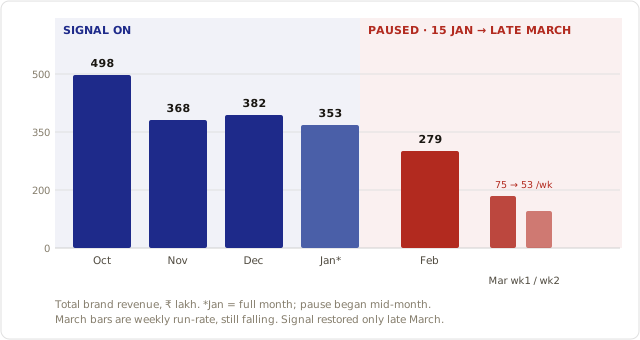
The “organic” channel did not hold. It fell off a shelf, and kept falling the whole time the signal stayed off.
Source: client account, anonymised. Dec → Feb: offline revenue −27%, brand revenue −27%. The decline carried on through most of March while the signal stayed off.
Three reads fall straight out of that chart, and they dismantle the belief that triggered the pause:
The objection I'll raise before you do
A sharp reader will notice spend also dropped over this stretch. So isn’t the revenue fall just “we spent less,” not “we pulled the signal”? Fair. I won’t dress this up as a controlled lab result, because it isn’t one. Here’s what it does and doesn’t prove.
Proven cold: the organic-footfall belief was wrong. When the ads pulled back, the supposedly self-sustaining 82% of the business fell with them, and kept falling for over two months. That conclusion needs no assumptions.
The expert read on causation: spend didn’t fall and then revenue follow. Both fell together, because a blinded account can’t absorb budget efficiently. CPA climbs, so spend bleeds down. The throttling is a symptom of signal loss, not an independent cause. The clincher a pure spend-cut story can’t explain: when the signal came back, the account became spendable and performant again. Same brand, same product, signal off then on. That arc is the closest thing to a holdout you get outside a textbook.
Switching it back on
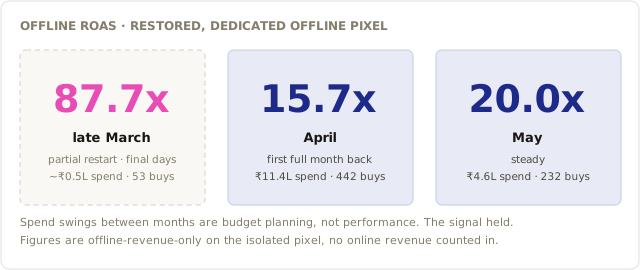
We restored offline CAPI in late March, and this time isolated it on a dedicated offline pixel, separate from the online one, so the offline contribution couldn’t be argued with. March itself was mostly lost (the signal returned only in its final days, on tiny spend). The first full months back tell the real story:
Source: client account, anonymised, restored offline pixel. ROAS here is offline revenue only, not blended.
Read it like this: the whole argument sits in one account. On, it scaled. Off, it collapsed for two-plus months. On again, it recovered. The brand had to lose the revenue to believe the signal was real. You don’t have to.





 · Oct 14, 2026