When Meta ads fatigue, should you change your message or your angle?
Short answer
Change the angle. An angle is one way of showing the promise to one kind of buyer in one moment, and the angle is what tires. On one D2C phone case account, a single promise carried monthly ad spend from ₹52 lakh to ₹2.93 crore over thirteen months while the angles kept changing.
When results dip, most teams go looking for a new message. It feels like progress, but it throws away the most valuable thing a scaling brand owns: a promise the market has started to remember. Every new message makes the audience, and the algorithm, learn the brand from scratch.
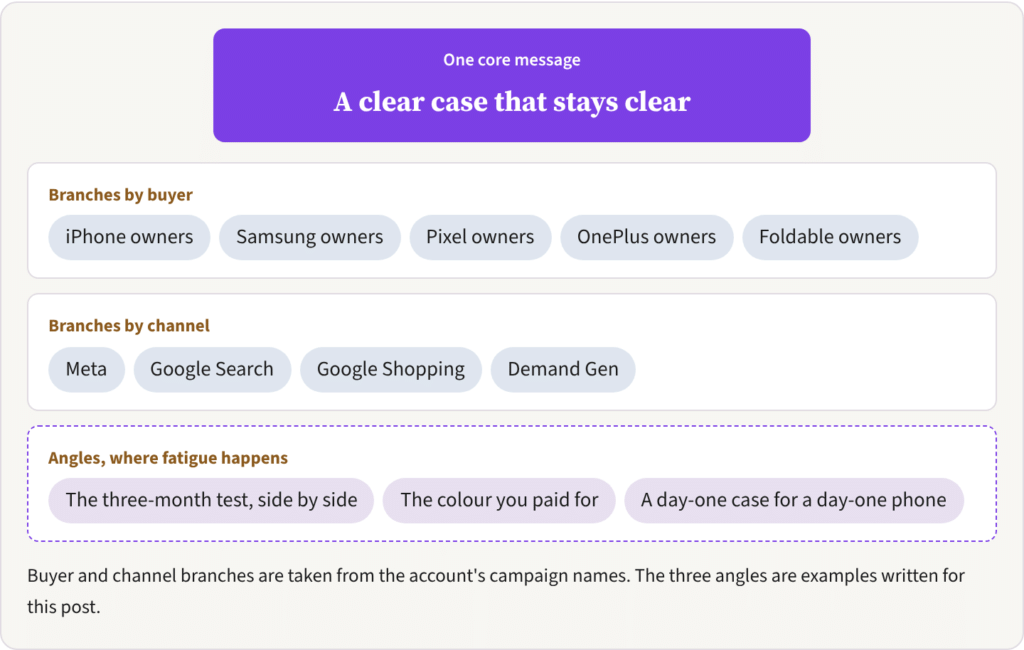
The promise here was narrow enough to remember and broad enough to stretch. You can see the stretch in the account’s own campaign list. The same “won’t turn yellow” idea runs by name through separate campaigns for iPhone, Samsung, Pixel, OnePlus and foldable owners, across Google Search, Shopping and Demand Gen, alongside the Meta campaigns, so one sentence travels down many roads.
We call this structure the Adbuffs Message Tree. The message sits at the top and does not move. Below it are the branches: the buyers, devices and channels it reaches. At the tips are the angles, the specific ads. When an ad tires, you cut a tip and grow another, and the tree keeps everything the market already knows.
Myth 2
“You can't steer on first-click data until it's set up inside Meta.”
What the account showed
For five months, GA4’s first-user campaign revenue against Meta spend was enough to decide where the money went.
How do you calculate first-click ROAS in GA4 without changing Meta settings?
Short answer
Take GA4’s first-user campaign revenue, the revenue from users each campaign first brought to the site, and divide it by that campaign’s spend. On one account, GA4 first-click revenue against total Meta spend stayed between 0.91 and 1.21 every month from August to December 2025, while Meta spend grew from ₹50.18 lakh to ₹1.26 crore.
GA4 already records the campaign that first brought each user to the site, so every campaign gets a first-click ROAS with nothing changed in Meta. From August to December 2025 we steered the account on exactly that: a GA4 sheet of first-user campaigns, each with its first-click ROAS, with weak campaigns highlighted for review.
Meta spend against GA4 first-click revenue, before any first-click setup in Meta
The number to watch is not the level, which first click always keeps low, but the line. It stayed near 1 while Meta spend grew two and a half times. When the account later moved to first-click campaigns inside Meta, the same message carried straight across; we followed that rollout month by month in What a year of scaling Meta on first-click data taught us.
Myth 3
“First-click data tells you which campaigns to cut.”
What the account showed
The campaigns that looked worthless on first click looked like the best in the account on last click. The account needed both.
Should you cut Meta campaigns that show low first-click ROAS?
Short answer
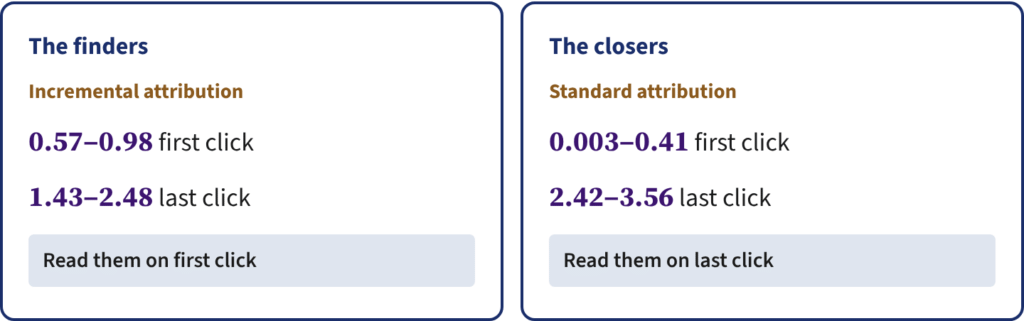
Not before checking the job each campaign was built to do. On one account, campaigns built to close engaged buyers showed first-click ROAS of 0.003 to 0.41 but last-click ROAS of 2.42 to 3.56. Campaigns built to find new buyers showed higher first-click and lower last-click ROAS. Read finders on first click and closers on last click.
Two kinds of prospecting campaign ran side by side, set up with different Meta attribution models. Campaigns on incremental attribution were built for top-of-funnel discovery, reaching people new to the brand. Campaigns on standard attribution reached people already engaged, and closed the sale.
ROAS on first click / last click, August to December 2025
On first click alone, the closers look like wasted money, while their last-click numbers make them the stars of the account. Both readings miss the point. A closer is almost never the first touch, so first click will always undersell it; a finder often hands the sale to something else, so last click undersells that one. Cut the closers and the buyers the finders warmed up drift to whoever asks them next. Cut the finders and the closers soon have nobody new to close.
Decide each campaign’s job first, then read the number that measures that job. It is the same two-number discipline we apply on Google in our post “Why your Google Ads ROAS falls apart when you scale it”.
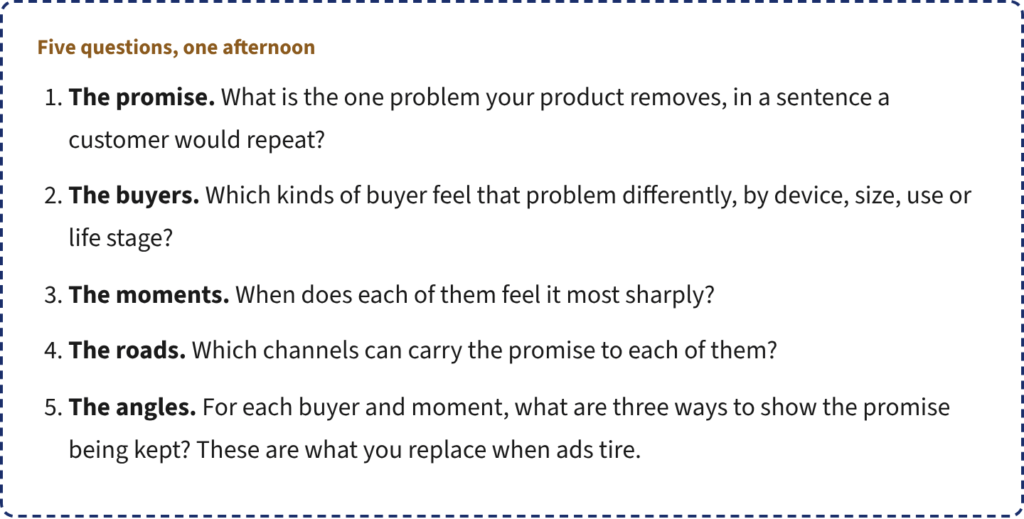
How do you build an Adbuffs Message Tree for your brand?
Can one core message take credit for all this growth?
No. This is one brand in one category, during a year when its measurement was also changing, so we can’t separate how much of the growth came from the message, the first-click work or the market. Revenue trailed spend in five of the twelve months from September 2025 to August 2026: October, November, January, March and April. From May to August it kept pace or did better. The first-click figures from August to December set GA4 revenue, which covers all channels, against Meta spend alone, so read them for direction. The three angles in the tree are illustrations, not the brand’s ads.



 · Nov 20, 2026