Why do Google Shopping titles copied from your website underperform?
Short answer
Google Shopping has no keywords to bid on. Google decides which searches a product appears for largely from the title and description in your feed. A website title carries the product name and brand, so it matches people searching for that name, who were likely to find you anyway, and misses everyone searching by need.
In a search campaign you choose the keywords. In Google Shopping you do not. Google reads your product feed and decides which searches each item is relevant to, and the title carries most of that weight. Whatever the title says is, in effect, your keyword list.
Most brands never write that list. The feed pulls product titles straight from the website, and website titles are written for people already on the site: a product name, sometimes a translated version of it, and the brand. A name-and-brand title works on a product page. In a Shopping auction it narrows the listing to people searching for that exact name.
The problem gets sharper when you sell abroad. An Indian brand selling Ayurvedic supplements in Germany had titles built from the product name, a German version of it and the brand. A German shopper looking for that kind of product types “ayurvedische Kräutertabletten” (Ayurvedic herbal tablets), searches an ingredient by its botanical name such as Withania somnifera, or describes what they want it to do. None of those words were in the title, so the listing had little to match those searches with, and nothing in it told the shopper why to click.
The trap in one line
If your Shopping title only says what you call the product, Google mostly shows it to people who already know that name, and those people were going to find you anyway.
How do you write a Google Shopping title that matches what people search?
Short answer
Start from the Shopping search terms that already produce sales, then fill gaps with keyword research in the market’s language. Put the product type in plain local words, the key ingredient as shoppers search it, the benefit or use, and the pack size where buyers compare on it. We call this the Adbuffs Search-Matched Title.
Three rules, written from demand
What is the Adbuffs Search-Matched Title?
Rule one. Start from what converts. Pull the Shopping search terms that already produce sales and build the title around their words, not around the product name.
Rule two. Write in the shopper’s language. Translating the catalogue is not enough. Use the words local shoppers type, including botanical or technical names where that is how they search.
Rule three. Say what it is, what is in it and what it does. Product type, key ingredient and benefit each get a place in the title, with pack size where buyers compare on it.
Adbuffs Search-Matched Title = product name + pack size | product type in plain local language | key ingredient as shoppers search it | benefit or use
Applied to the two products below, the formula gives these titles. Brand and product names are replaced with labels in square brackets; the German descriptive parts are the real titles.
Website title against Adbuffs Search-Matched Title
In English, the first new title reads “Ayurvedic iron supplement for women | pearl oyster and Ayurvedic herbs | dietary supplement”, and the second “Ayurvedic fruit-and-herb preparation | amla (amalaki)”. Each segment matches a way people search for the product.
Descriptions get the same treatment, with more room: the full ingredient list and where it is sourced, the traditional Ayurvedic context, dosage and usage, and certifications such as lab-tested, vegan, gluten-free or organic. The rewritten titles and descriptions went into a custom feed, so the website kept its own product names and the feed could be tested against them.
Did search-matched titles improve Shopping results on a live account?
Short answer
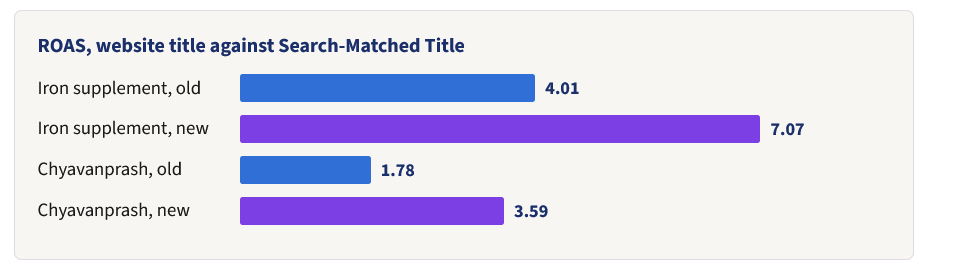
Yes, on both products tested, on small volumes. For an Ayurvedic brand in Germany, the iron supplement’s conversion rate rose from 7.42% to 13.19% with the rewritten title, and the chyavanprash’s ROAS went from 1.78 to 3.59. Each listing recorded only about two to three conversions, so read the direction, not the decimals.
For each product, the original website title and the Adbuffs Search-Matched Title ran as separate listings in the brand’s Shopping campaigns in the same month: May 2026 for the iron supplement and June 2026 for the chyavanprash.
On these numbers
These are real Google Ads figures from an account we manage, with the brand and product names anonymised and the numbers unadjusted. The volumes are small: each listing recorded between 2.11 and 3.04 conversions (Google can split credit for one sale, so counts can be fractional) and roughly 16 to 50 clicks.
Women’s iron supplement, May 2026 . price €29.99
A larger share of people who saw the new title clicked it, and a far larger share of those clicks bought. Conversion rate rose from 7.42% to 13.19% and each conversion cost €5.51 less. The rewritten listing brought in slightly more conversion value on about a third less spend.
Chyavanprash 450 g, June 2026 . price €29.99
The second product is the more interesting one, because the click-through rate went the wrong way. Fewer people clicked, and yet conversion rate rose from 6.19% to 8.01%, ROAS doubled and the listing brought in 15% more conversion value while spending 43% less.
We also raised the budget behind a third rewritten listing, an Ayurvedic Brahmi product, and its sales went from €134 to €460 in a month. The Brahmi gain is a budget result as much as a title result, so we read it only as a sign that the new listing held up when more money went behind it.
Is a lower click-through rate on Google Shopping a bad sign?
No, not on its own. Most Shopping reports put click-through rate near the top, and most people read a falling CTR as a problem. On a Shopping ad, though, every click is paid for. A vague title invites curious browsers to click, and you pay for each of them. A precise title tells the shopper exactly what the product is before they click, so people who were never going to buy can scroll past for free.
The chyavanprash numbers fit that pattern: clicks fell, conversion rate rose and spend dropped while conversion value grew. Judge a title on conversion rate, cost per conversion and ROAS. CTR tells you how many people were curious, not how many were buying.
What two products can and cannot show
These are two products in one market, and each listing recorded only two to three conversions. At that volume one extra order moves conversion rate by several points, so the size of each gain is not reliable even though the direction held on both products. Comparing both titles in the same month limits seasonality, but Google decides which listing to show in each auction, so traffic was not split at random the way a controlled A/B test would split it. Before rolling Adbuffs Search-Matched Titles across a whole catalogue, run them on your top sellers for four to six weeks and check the same metrics on real volume.
How do you test new Shopping titles on your own feed?
You can set up an Adbuffs Search-Matched Title test on a handful of products in a week. The work is in the research and the writing, not in the setup.
- Pick your top sellers. Start with five to ten products that already get Shopping traffic, so the comparison builds volume quickly.
- Pull the converting search terms. In Google Ads, open the search terms report for your Shopping campaigns, filter to terms with conversions, and group them by product.
- Research in the market’s language. Fill the gaps with keyword research by someone who speaks the language natively. Note the ingredient names, product types and benefit phrases shoppers use.
- Write the title. Product name and pack size, then product type, key ingredient and benefit, separated cleanly. Google allows up to 150 characters, but shoppers usually see only the first 70 characters or fewer, so put the words that win the click first.
- Rewrite the description. Ingredients and sourcing, how to use it, and certifications. For food supplements sold in the EU, have benefit wording checked against the EU rules on health claims before it goes live.
- Load it as a custom feed. Keep the website’s product titles unchanged and add the new titles and descriptions in Merchant Center as separate items with their own IDs, so the original listing stays live for comparison.
- Run both titles at once and compare on the right metrics. Keep the original listing live alongside the new one over the same period, then compare conversion rate, cost per conversion and ROAS. Do not kill a title because its CTR fell.
- Wait for volume. Give each test four to six weeks or enough conversions to trust before rolling the format across the catalogue.
What founders ask us about Shopping titles





 · Nov 20, 2026