Why are Meta prospecting campaigns reaching existing customers?
Short answer
Because Meta optimises for the cheapest conversions it can find, and past buyers convert more cheaply than strangers. Prospecting campaigns keep their names and targeting while delivery fills up with past customers. ROAS rises, cost per purchase falls, and the number of first-time buyers barely moves.
A prospecting campaign is set up to reach people who do not know you yet. Meta’s delivery, though, is built to find conversions, and on a brand with a strong repeat habit the algorithm learns quickly where the easy ones are. The campaign keeps its name while its delivery shifts towards the existing base.
The reporting rewards the shift. Past customers buy readily and spend more per order, so the campaign posts a lower cost per purchase and a higher ROAS than an honest prospecting campaign could. The team sees a strong account and adds budget. Meanwhile first-time buyers barely move, repeat customers become a larger share of revenue, and growth stalls once the existing base is fully harvested.
The account in this post showed the pattern. Most of its campaigns were built for cold audiences, yet a large share of the budget was reaching people who had already bought, and in July about three in five of its Shopify customers were still returning buyers.
The trap in one line
If your prospecting campaigns post your best ROAS, check who they are reaching, because your own customers are among the cheapest conversions in your account.
How do you stop Meta prospecting from chasing past buyers?
Short answer
Change what Meta is rewarded for rather than only excluding past customers. Pause ad sets that feed the existing base, launch broad campaigns, set the new ad sets to incremental attribution so Meta favours conversions its ads caused, and ship new creative every week. We call this the Adbuffs Acquisition Reset.
The obvious fix is to exclude past customers from every prospecting campaign. A hard exclusion can backfire: it removes a large, high-intent pool from delivery and can leave the algorithm struggling. The better lever is to change what the algorithm counts as success, so it chooses new customers on its own.
Meta’s incremental attribution setting changes what counts as success. Instead of crediting any purchase within a set window after a click or view, it optimises delivery towards conversions that Meta’s models predict the ad caused. A past customer who was going to reorder anyway counts for very little, so the algorithm has less reason to chase them.
Five rules, one goal: first-time buyers
What is the Adbuffs Acquisition Reset?
The Adbuffs Acquisition Reset is a way to turn prospecting campaigns back towards first-time buyers and judge them on new customers counted in the store.
Rule one. Read the segments. Use Meta’s audience segment breakdown to see what share of spend reaches existing customers, engaged audiences and new audiences.
Rule two. Prune what feeds the base. Pause campaigns and ad sets with a high share of spend on existing customers, low ROAS or duplicated creative.
Rule three. Go broad. Launch new campaigns with broad targeting and only the demographic limits your product needs, so the algorithm has room to find new people.
Rule four. Reattribute. Set the new ad sets to incremental attribution, so Meta favours conversions its ads caused over ones that would have happened anyway.
Rule five. Refuel every week. Without returning buyers to lean on, the algorithm needs new creative to keep learning. Ship fresh hooks and angles weekly.
Existing-customer spend share = spend reaching existing customers ÷ total spend
New customer acquisition cost (NCAC) = total ad spend ÷ new customers
How much Meta spend reaches existing customers?
Short answer
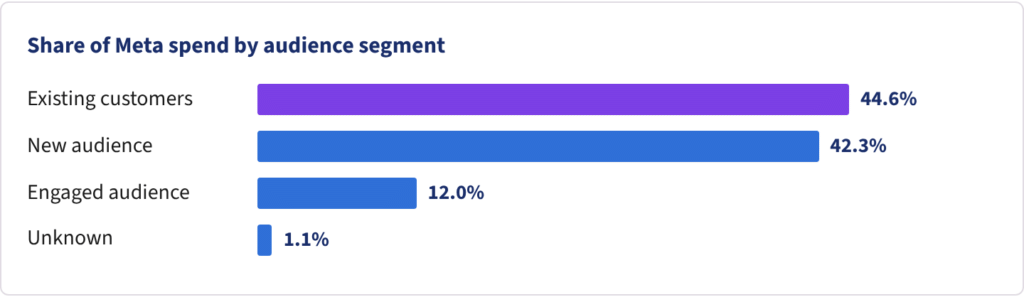
On one D2C herbal wellness account, 44.6% of Meta spend in the audience segment report reached existing customers, more than the 42.3% reaching new audiences, in an account built mostly for prospecting. Existing customers also showed the best ROAS, 2.51 against 1.61 for new audiences.
The account belongs to a D2C herbal wellness brand we manage in India. Meta’s audience segment report showed where its spend was going.
On these numbers
These are real figures from an account we manage, with the brand anonymised and the numbers unadjusted. The audience segment figures come from Meta Ads Manager; the report’s date range is not in our source, and it covers ₹54.38 L of spend, more than the ₹40.02 L spent on Meta across July and August combined, so it covers a different or longer period than those two months. New customers come from Shopify, and spend from Meta and Google Ads, for July and August 2026. One of the reset campaigns carries a mid-July date in its name, so July probably includes part of the reset.
Audience segment breakdown · Meta Ads Manager
Existing customers also looked like the strongest audience on the platform’s own numbers: the highest ROAS at 2.51, the largest orders at ₹778, and a cost per purchase of ₹310 against ₹378 for new audiences. New audiences, the people the campaigns were built to reach, showed the weakest ROAS of the three main segments at 1.61, so any optimisation that chased ROAS would have pushed spend further towards the existing base.
We paused the campaigns and ad sets with a high share of spend on existing customers, low ROAS or duplicated creative, and launched broad campaigns targeting women over 24. The new ad sets ran on incremental attribution, with new creative carrying fresh hooks and problem-solution angles shipped every week. The switch made scaling harder at first, because the algorithm lost its easy repeat sales; the team answered with a high volume of new creative every week to steady ROAS and keep raising budget.
Did new customer acquisition cost fall during the reset?
Yes. Each new customer cost ₹595 in August against ₹895 in July, 34% less, while total ad spend rose 53%. The account added 4,603 new customers against 1,998 in July, an increase of 2,605, or 130%. Returning customers held almost level, up 3% on Shopify, so the existing base kept buying while new-customer numbers climbed. Returning buyers went from about three in five customers in July to about two in five in August.
Spend, new customers and cost per new customer · July against August 2026
Spend rose 53% and new customers rose 130%, so each new customer cost about a third less: ₹595 against ₹895. Platform ROAS credits fewer easy repeat sales after a reset like this, so it can look flat or worse even while the business acquires customers more cheaply. Judge the change on new customers, counted in your store rather than in Ads Manager.
What one month against another can show
Spend rose 53% between the two months, and Google Ads spend more than doubled, so some of the new customers came from more budget and from Google rather than from the Meta reset alone. The fall in cost per new customer is the stronger signal, because more budget on its own usually makes each customer more expensive, not less. Shopify counts every first-time buyer, whatever brought them in. Meta’s incremental attribution is itself a model of what its ads caused, not a controlled test. To prove what the reset adds, hold out a region and compare, as we describe in “The one number that tells you if you’re actually growing”.
What are the steps to run an Adbuffs Acquisition Reset?
You need Meta’s audience segments set up with your customer list, a store that reports new and returning customers, and the capacity to produce new creative every week.
- Set up audience segments. In Meta’s advertiser settings, define your existing customers and engaged audience, so reporting can split results by segment.
- Read the split. Break down your prospecting campaigns by audience segment and note the share of spend reaching existing customers.
- Prune. Pause ad sets with a high existing-customer share, low ROAS or duplicated creative. Leave dedicated retention campaigns alone; they are meant to reach past buyers.
- Go broad. Launch new prospecting campaigns with broad targeting and only the demographic limits your product needs.
- Switch to incremental attribution. Choose incremental attribution when you create each new ad set, before you publish it.
- Ship creative weekly. Expect returns to dip at first. A steady flow of new hooks and angles gives the algorithm the material it needs to find new buyers.
- Judge on new customers. Track new customers and new customer acquisition cost from your store every week, not platform ROAS.
- Prove it with a holdout. Pause the new setup in a test region to measure what it adds.
What founders ask us about prospecting






 · Nov 20, 2026