What happened when one brand switched its offline signal off?
Short answer
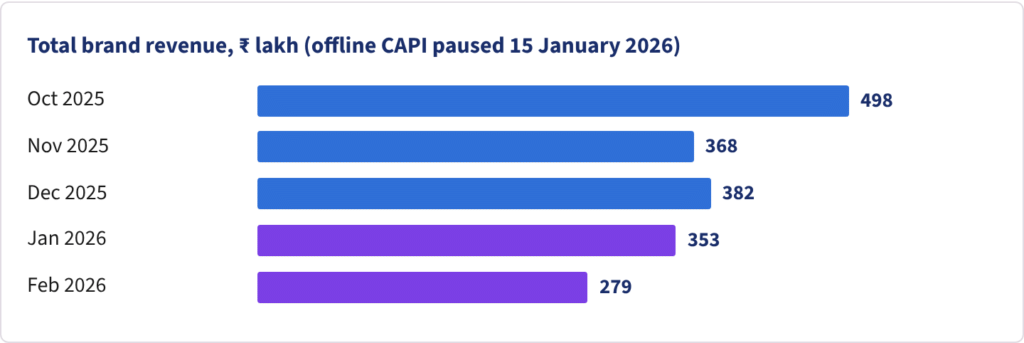
A multi-city South Indian jewellery brand paused every offline CAPI campaign on 15 January 2026, believing store sales were organic. From December to February, brand revenue fell 27%, offline revenue fell 27% and online revenue fell about 29%. Ad spend fell too, so the comparison is not a controlled test.
On these numbers
These are real dashboard figures from an account we manage, with the brand anonymised at its discretion. Revenue covers the brand’s stores across several cities and its online store. Offline ROAS is offline revenue only, measured on the dedicated offline pixel; it is not blended and not comparable to whole-account ROAS.
The brand had run Meta campaigns with offline CAPI feeding store purchases back to Meta, and stores made up 82–87% of brand revenue. Leadership came to believe that store footfall was organic and the ads played no part in it. On 15 January 2026 the brand paused every offline CAPI campaign and set up a new website-only pixel to put the budget behind online sales. Online revenue ran at roughly ₹50–90 lakh a month, against ₹300–400 lakh from the stores.
Revenue had already come down from its October peak before the pause. From December to February it fell another 27%. In March, weekly revenue went from about ₹75 lakh in the first week to about ₹53 lakh in the second. The signal came back only in the last days of March, so the signal was off for most of that month too.
Two things in the decline matter more than its size. The stores, the supposedly organic part of the business, fell as hard as the brand did. That fall is hard to square with the belief that store sales owed nothing to the ads. And online revenue, the channel the budget had moved to, fell about 29% instead of rising. Removing the offline signal did not protect online sales; both fell together.
The objection worth raising first
Ad spend fell during the pause as well, from about ₹42.8 lakh in December to about ₹25.3 lakh in February, a steeper drop than revenue’s. Jewellery demand is also seasonal. So the pause cannot prove on its own that the missing signal caused the fall. What it does show is that store sales were not independent of the ads, and that offline results recovered once the signal returned. On blended ROAS the paused months even look better, about 11x in February against about 9x in December, because spend fell faster than revenue. That on, off, on arc is the closest thing to a holdout test this brand had, and it is not a controlled one.






 · Nov 20, 2026