Insights · Meta Ads
How do you win new customers on Meta without excluding your buyers?
Key takeaways
- Excluding every existing customer from a Meta campaign removes its strongest conversion signal. On a high-repeat personal care account we manage, delivery worsened and cost per result rose.
- The Adbuffs First-Click Fix keeps existing customers in the audience and changes only the optimisation event, from standard Purchase to a First Click Purchase event that counts only purchases credited to a person’s first recorded ad interaction.
- In a Meta conversion lift test on matched spend, First Click Purchase drove 170 incremental new-customer orders against 53, at $10.21 each against $32.85, with 98% confidence against 65%.
Abhishek Maity, Co-founder, Adbuffs
Brands in high-repeat categories reach for the same fix when new-customer growth slows: exclude everyone who has bought before. On one personal care account, the exclusion made things worse, and the change that worked left the audience alone and changed what the campaign was optimised for.
Why does excluding existing customers hurt Meta delivery?
Short answer
Because past buyers send Meta its strongest conversion signal. When one personal care brand removed its whole customer base from a standard Purchase campaign, delivery worsened and cost per result rose. Reaching new customers is the right goal; excluding buyers is the wrong tool.
The account sells personal care products, sanitary pads among them, in a category where customers reorder on a cycle. A high repeat rate is good for the business and awkward for prospecting: the easiest conversions in any campaign are the people who already buy.
The brand first tried the obvious fix. It excluded its entire customer base from a standard Purchase campaign so that every rupee would have to find someone new. Delivery worsened and cost per result rose. The campaign had lost the audience that taught it what a buyer looks like.
The brand then let existing customers back in. Topline numbers recovered, but standard Purchase optimisation drifted back to the easiest converters, who in a high-repeat category are mostly repeat buyers. New-customer growth lagged, and the dashboard did not show the lag, because a repeat purchase and a first purchase look the same in reported ROAS.
The trap in one line
Excluding buyers starves the algorithm, and including them under standard optimisation lets it feed on them. The audience was never the lever.
What is a First Click Purchase event?
Short answer
A First Click Purchase event is a custom event, built and sent by the advertiser, that counts a purchase only when it is credited to the person’s first recorded interaction with an ad. Optimising a Meta campaign to this event rewards delivery that brings people into the funnel. The standard Purchase event rewards whoever converts most easily.
The standard Purchase event fires on any completed purchase and credits it to the ad that won the attribution window, whoever the buyer is. The algorithm learns that any buyer is a good buyer, so it chases the cheapest conversions it can find. In a high-repeat category, those are your own customers.
A First Click Purchase event changes the lesson. The campaign earns credit only when its ad was the person’s first recorded interaction, a rule built to tilt delivery towards people new to the brand’s demand pool. Existing customers stay in the audience and keep the signal strong; they stop being the cheapest win.
Change the event, not the audience
What is the Adbuffs First-Click Fix?
The Adbuffs First-Click Fix is a way to grow new customers on Meta in a high-repeat category without starving delivery.
Step one. Stop excluding existing customers. Put your buyers back in the targetable pool so the campaign keeps its strongest conversion signal.
Step two. Switch the optimisation event. Optimise the campaign to a First Click Purchase event instead of the standard Purchase event.
Step three. Keep the audience full. Leave audience, budget and creative as they are, so the event is the only thing that changes.
Step four. Measure with a lift study. Judge the change on incremental new-customer orders from a Meta conversion lift test, not on reported ROAS.
Did First Click Purchase find more new customers in a lift test?
Short answer
Yes. In a Meta conversion lift test on matched spend, the First Click Purchase campaign drove 170 incremental new-customer orders against 53 for standard Purchase, 3.2 times as many, at $10.21 per order against $32.85. It reached 98% confidence; the standard campaign reached 65%, below the usual 90–95% bar.
On these numbers
The figures come from a Meta conversion lift test on a high-repeat personal care account we manage, with the brand anonymised. The lift results are reported in US dollars. Test dates, duration and total spend are not published; orders multiplied by cost per order put each campaign at about $1,740, which is consistent with the matched spend the test reports.
Conversion lift results on matched spend · Meta
The two campaigns spent the same and differed only in the event they optimised for. First Click Purchase found 3.2 times the incremental new customers, and each one cost under a third as much. Incremental sales on the same spend were about 2.2 times higher.
The confidence figures matter as much as the orders. The standard Purchase result reached 65%, short of the 90–95% bar most teams use before calling a result reliable, so the test cannot show the standard campaign added new customers at all. The First Click Purchase result cleared that bar comfortably at 98%. That gap is the finding, not a footnote: only one of the two setups produced a result you could act on. The 3.2 times figure compares a reliable estimate with an unreliable one, so read it as the size of the gap this test observed, not a fixed multiplier.
Three setups on the same account
The campaign was being asked to find any buyer, and in a high-repeat category the cheapest buyer is a returning one. Changing what the campaign was rewarded for changed whom it found.
For a year of scaling Meta with first-click campaigns on another account, read What did scaling Meta from ₹50 lakh to ₹2.89 crore a month teach us about first-click data?
How do you run the Adbuffs First-Click Fix on your own account?
You need a First Click Purchase event sent to Meta alongside your standard Purchase event, enough spend to run a conversion lift test, and the patience to change one thing at a time.
- Remove the exclusion. Take the existing-customer exclusion audience off your prospecting campaign.
- Set up the event. Send Meta a First Click Purchase event that fires only for purchases credited to a person’s first ad interaction.
- Change only the event. Switch the campaign’s optimisation event to First Click Purchase and leave audience, budget and creative untouched.
- Run a conversion lift test. Compare a standard Purchase campaign and a First Click Purchase campaign on matched spend, each against a holdout.
- Read confidence first. Trust a result only once it clears 90–95% confidence, then compare incremental new-customer orders and their cost.
- Scale what cleared the bar. Move budget to the setup that produced reliable incremental new customers.
What founders ask us about first-click optimisation
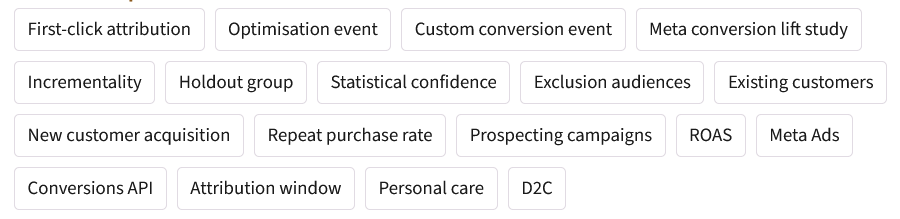
Glossary
Related concepts
The data comes from one Meta conversion lift test on an anonymised high-repeat personal care account, reported in US dollars. Test dates, duration and total spend are not published.





 · Nov 20, 2026