Your best channel can look like your worst
Most brands read one ROAS per channel, straight off the platform, and make spend decisions from it. That number is wrong in both directions, and the error compounds when you sell in more than one place.
Platform ROAS is reported on a last-touch basis on orders placed. It claims credit for buyers who would have purchased anyway, which flatters it. It also misses every sale that happens off the click: in a store, on a marketplace, through a phone order. And it counts the order the moment it is placed, before anyone has checked whether it was delivered and paid for.
In India that last point is not a rounding error. A cash-on-delivery order that goes return-to-origin costs you forward shipping, reverse shipping and handling, and returns zero revenue. If your revenue line still counts that order, your ROAS is fiction.
Now stack channels. You run D2C, Amazon, Flipkart, a couple of quick-commerce apps. Each one reports its own ROAS. None of them can see the others. So when your D2C ROAS dips, you cut D2C spend, and your Amazon sales quietly fall too, because a chunk of that Amazon demand was being created by the D2C engine you just throttled. You optimised one box and broke the system.
The trap in one line If you judge each channel by its own reported number, you will starve the channel that builds demand and over-feed the channel that harvests it.
True Omnichannel MER
MER, the marketing efficiency ratio, is simply total revenue divided by total marketing spend. It is a blunt instrument on purpose. It does not care which channel gets the credit, so it cannot be gamed by attribution. The problem is that most people calculate it lazily: gross revenue on top, media-only spend on the bottom. That version flatters you twice.
Our version makes two corrections, and those two corrections are the whole framework.
The Adbuffs framework
True Omnichannel MER
Rule one. Net the top. Revenue is net-delivered: gross, minus discounts, minus a provision for returns and cancellations. A failed order never enters the ratio.
Rule two. Load the bottom. Spend is fully loaded: ad media plus 18% GST, plus WhatsApp, plus influencer cash. Every rupee that left the marketing budget counts.
True Omnichannel MER =
( D2C + marketplace + quick-commerce revenue, net of returns & cancellations )
—————————————————————————————————————————
( ad media + 18% GST + WhatsApp + influencer )
Read the blended figure for the whole business. Read each channel’s own figure underneath it. The gap between them is the most useful diagnostic you have.
Netting the top is the move almost nobody makes. Putting gross order value in the numerator is why a brand can run a “2x ROAS” and still bleed: a fifth of those orders came back. By taking returns out before you measure, the delivery problem is absorbed on the revenue side, and you no longer have to carry a moving breakeven target in your head.
Loading the bottom is the move that keeps you honest. GST on advertising is real cash that leaves on the day you pay. If your brand reclaims it as input tax credit later, including it simply means your MER target carries a built-in safety margin, which is exactly where you want the margin to sit.
What this looks like on a live business
Below is a real omnichannel account we run, a wellness and personal-care brand selling across its own Shopify store, Amazon, Flipkart, Meesho, a quick-commerce app and a pharmacy marketplace. We track it every week on exactly this method.
On these numbers
The figures here are from a genuine account we operate, anonymised and adjusted so no client is identifiable. The shape of the story, the relationships between the channels and the size of the effects are true to the real data. The exact rupee values are not. Treat them as a faithful illustration, not an audited client result.
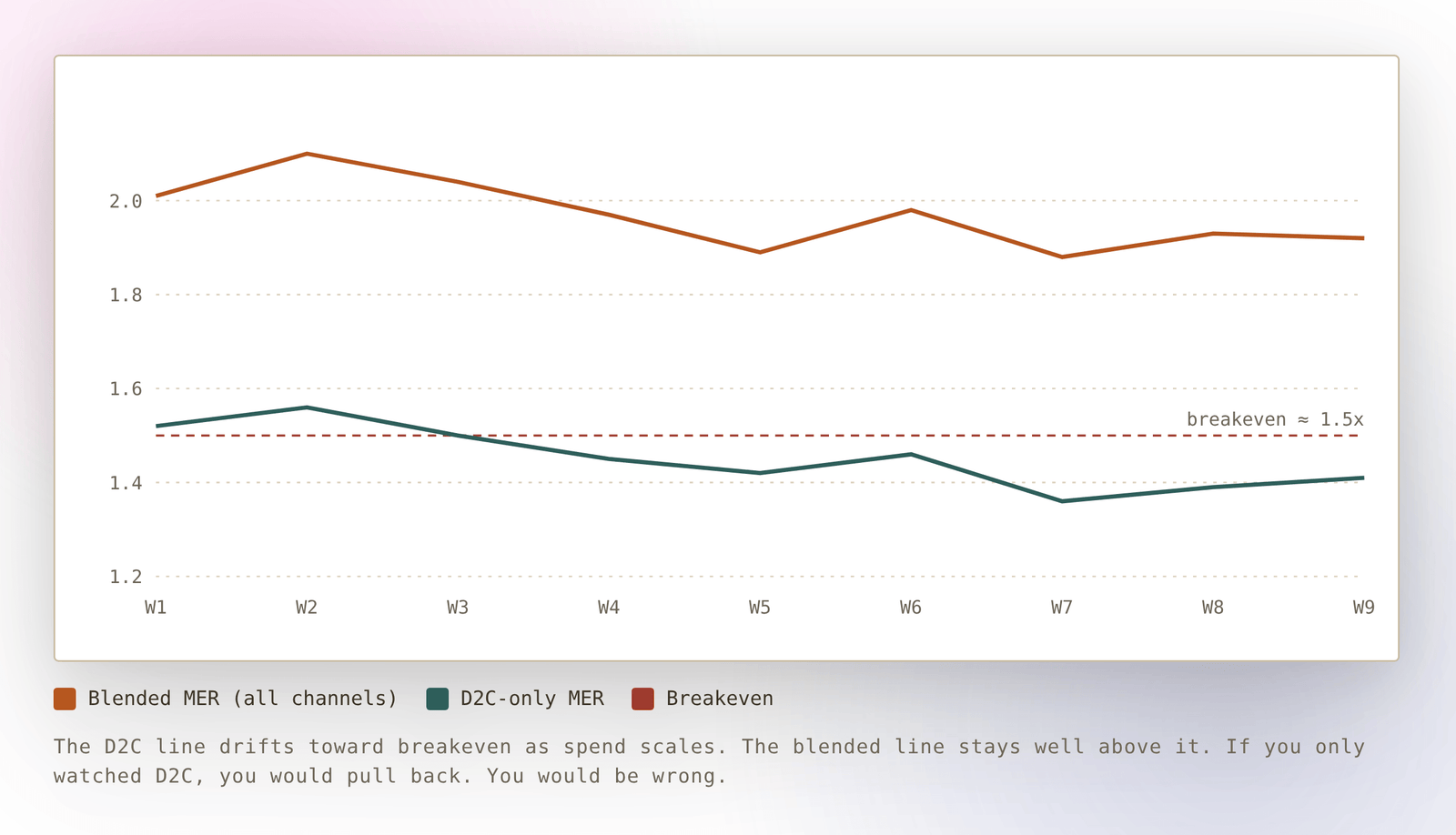
Here are nine weeks. Spend is loaded, revenue is net-delivered. Watch the two MER columns move.
Weekly Summary . Loaded Spend, Net – Delivered Revenue (₹ Lakh)
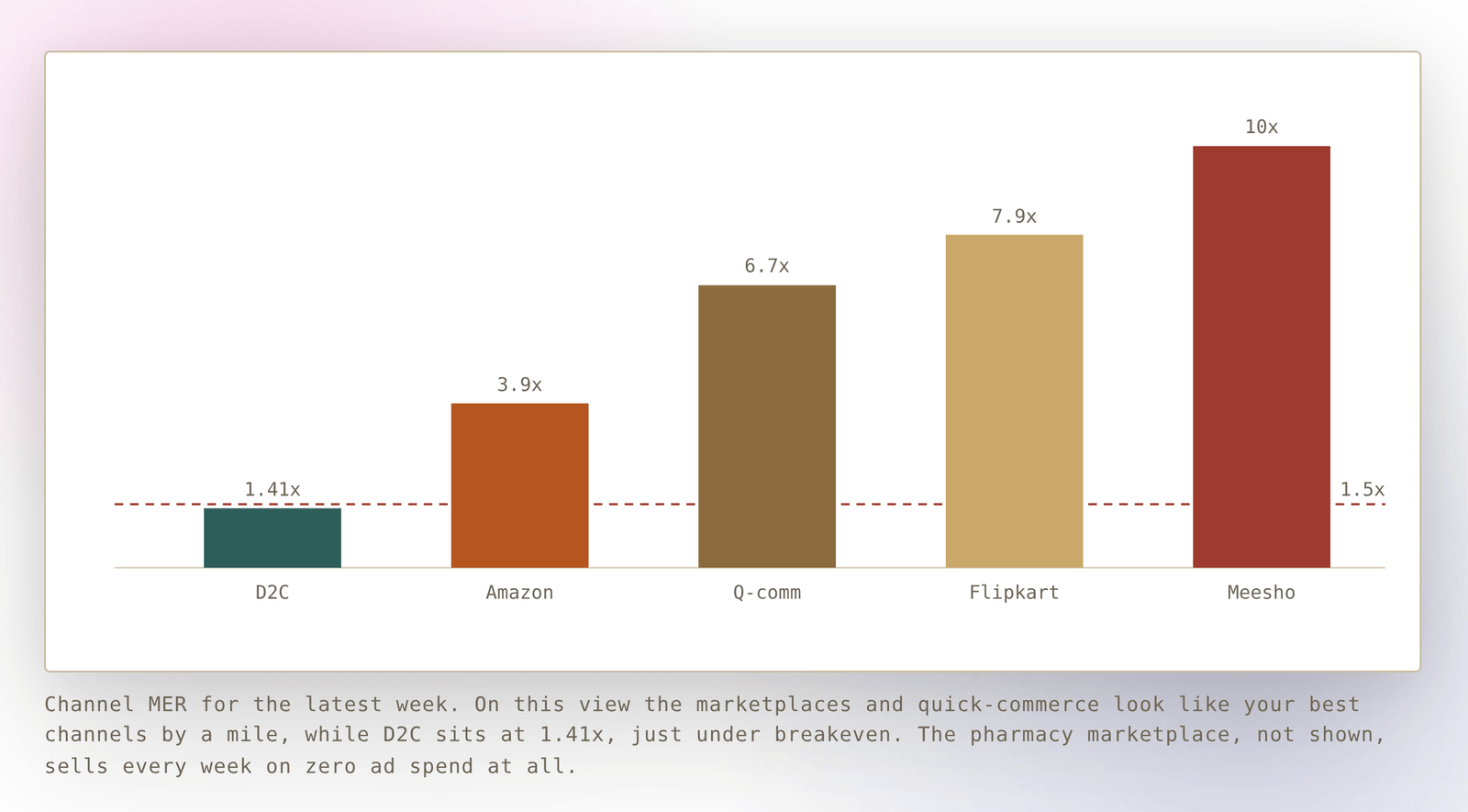
Now break the latest week apart by channel. This is where the lazy reading falls over.
The marketplaces are not winning on their own merit alone. They are riding demand the D2C engine creates. The pharmacy channel proves it: it spends nothing on ads and still sells every week. That is pure pulled demand. So the honest reading is not “D2C is weak, marketplaces are strong.” It is “D2C builds the demand, the marketplaces bank it, and the blended number is what is actually profitable.” This is the halo effect, and it is why you steer to the blended figure and never to a channel in isolation.
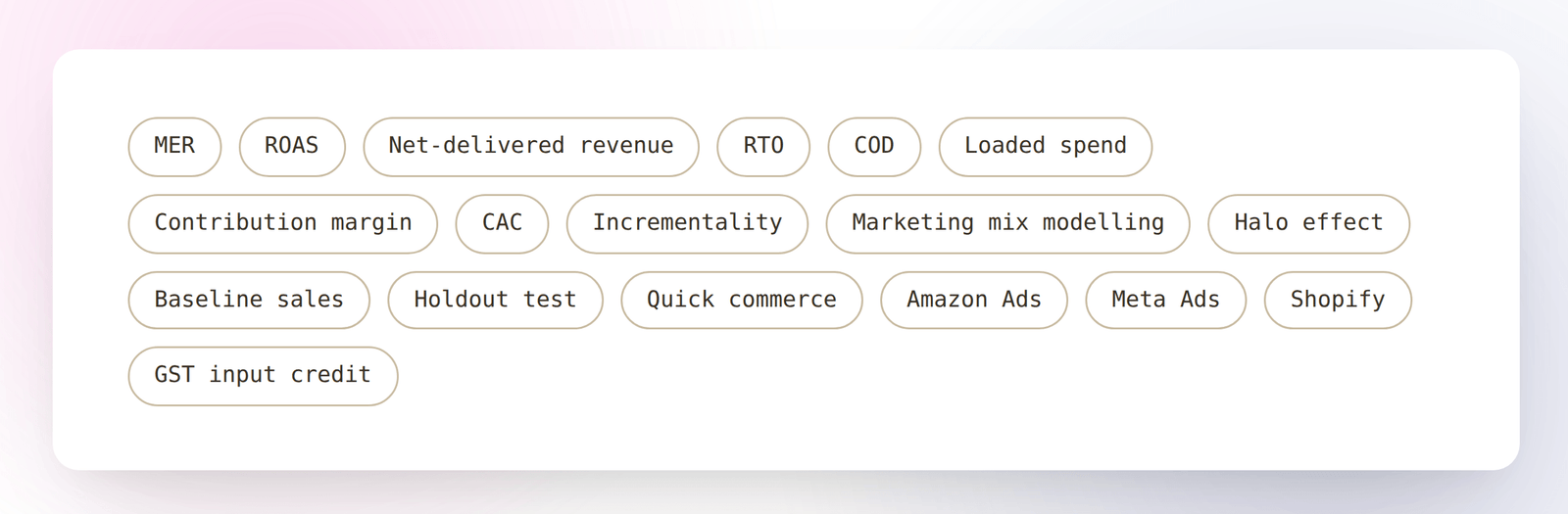
The terms, stated plainly
Your breakeven MER is an output, not a guess
People ask what MER they should aim for. There is no universal number. Your breakeven falls out of your unit economics, and once you net delivered revenue, it barely moves.
Take a simple, illustrative order. This model uses the same assumptions as our RTO economics work, so the pieces fit together: ₹600 average order value, 20% cost of goods, ₹80 forward delivery.
Per-order waterfall . illustrative ₹600 model
So at this cost structure you break even at 1.5x and every point above it is profit. Change the structure and the target moves in a way you can read off in seconds.
Breakeven MER by cost structure . illustrative
Why netting matters here
If you measured on gross order value instead, this target would not hold still. It would climb as delivery success fell, from roughly 1.7x at 95% delivered to well over 2x in the seventies. By netting returns out first, you collapse that moving target into one stable number. The delivery problem is handled on the revenue line, where it belongs.
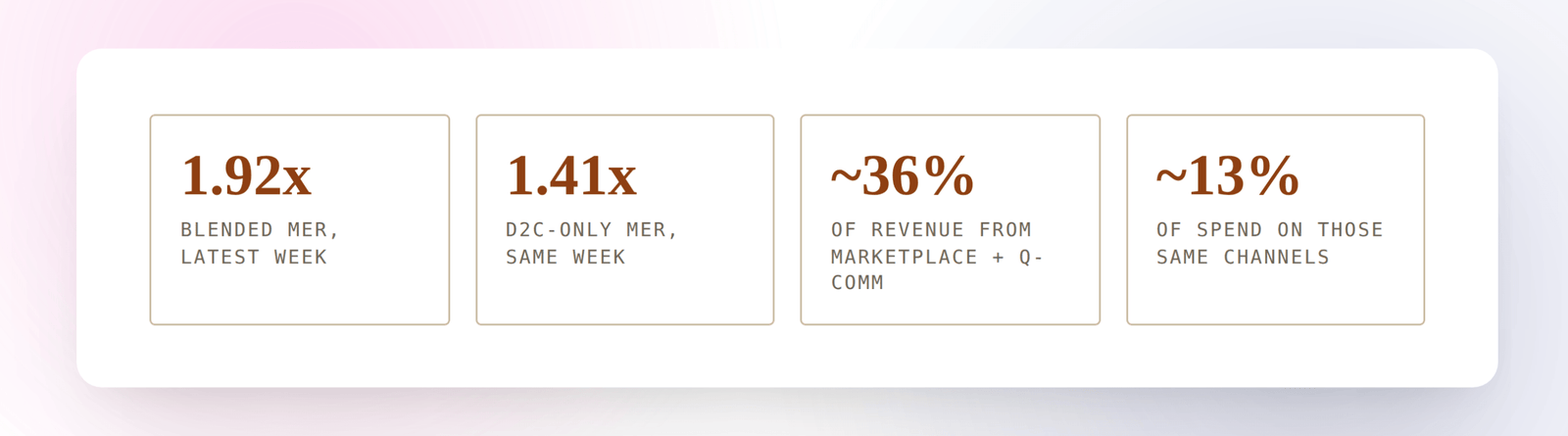
The 1.5x here is your D2C breakeven, built from D2C costs. Read it against your D2C revenue, not the blended figure. Marketplace and quick-commerce orders carry a different cost base, so the gap between blended 1.92x and this 1.5x is not a like-for-like cushion. What the blended number tells you is simpler and still the thing that matters: the system as a whole is making money. The D2C channel alone, at 1.41x, sits just under its own breakeven. That is not a channel failing. It is a channel funding the rest, and the next two sections show how.
Marketing mix modelling is cheaper than you have been told
MER tells you the machine is profitable. It does not tell you which lever is doing the work. For that you want a marketing mix model, and the dirty secret is that it is no longer expensive.
MMM has a fearsome reputation: six-figure engagements, a data science team, months of work. Most of that cost was never the statistics. It was assembling clean, consistent, channel-level spend and revenue, week after week, in one place. The kind of sheet we have been looking at in this article is that data. Once it exists, the modelling itself is an afternoon.
What a model actually does
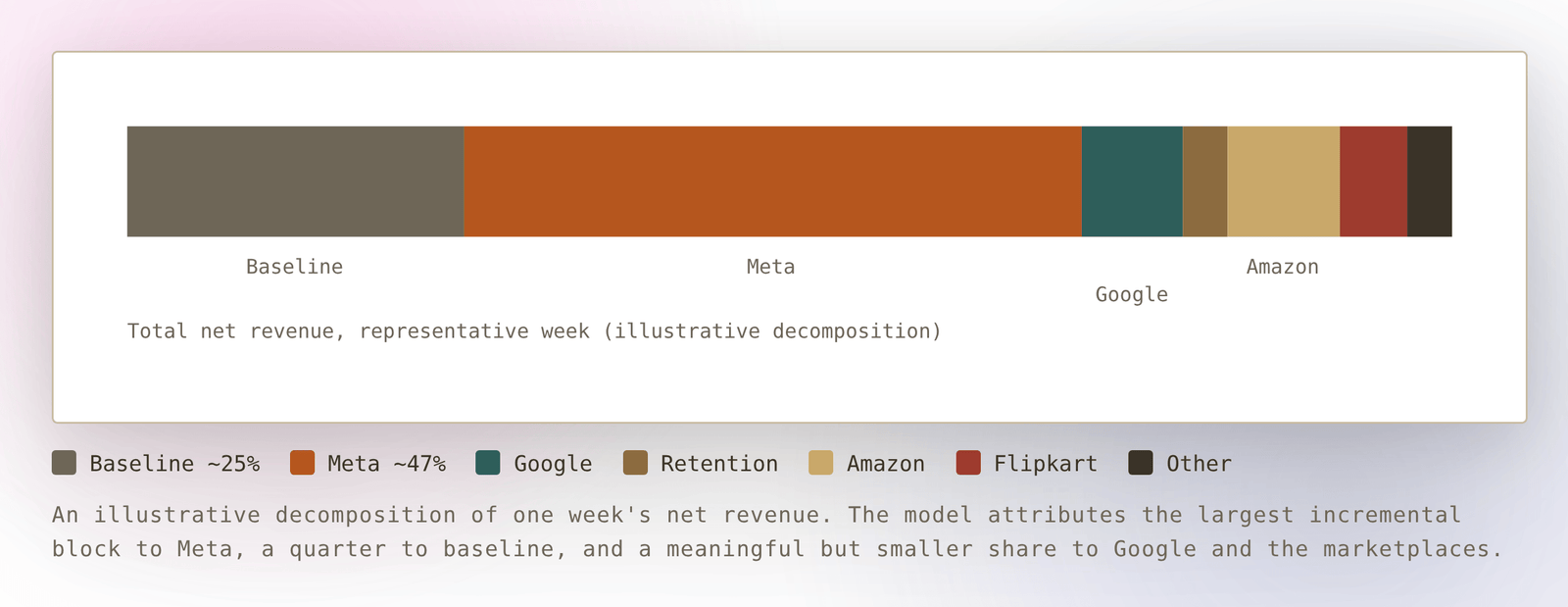
It looks at how revenue moves as each channel’s spend moves over many weeks, and splits total revenue into two things: a baseline you would keep at zero spend, and an incremental contribution from each channel on top. The pharmacy marketplace in our account shows the baseline in the open, steady sales on zero ad spend, around ₹2L a week. The model’s full baseline is far larger, roughly a quarter of revenue, because it also captures repeat buyers, organic and brand demand, and sales that paid channels created earlier and that land later without a click. That last part is a warning, not a free win. A simple model can park lagged halo in the baseline, which overstates how much revenue would actually survive if you cut spend. The only clean way to tell true baseline from lagged halo is a holdout test.
The bridge between the two views
Earlier, the channel cut showed marketplaces at about 36% of revenue. Here the model puts them at only about 17% of incremental contribution. The missing 19 points did not disappear. The model hands them to Meta, Google and baseline, because that is what created the demand the marketplaces banked. Same rupees, finally credited to the channel that earned them. That is the halo, measured.
How to read it, and what it answers
This is where you answer the questions that keep founders up at night. What is my Amazon revenue really worth if I am also running Amazon ads, and how much of it would arrive anyway? Which of Meta and Google is moving the business, and which is just collecting buyers I already had? The model gives you a per-channel incremental contribution, the extra revenue you get for the next rupee, and you compare it against that channel’s reported MER.
Reported VS Incremental . Illustrative Read
Add the reported side up and it attributes more revenue than the business actually made. That is not a mistake in the table. It is every channel claiming the same buyers, which is exactly the double-count this whole article is about. The gap between the two columns is the lie ROAS was telling. Google looks like the best channel on reported MER and the weakest on incremental, because it captures people who were already searching your brand. Meta looks ordinary on reported MER but is doing the heavy lifting of creating demand the other channels then bank. This is the same truth our incrementality work reaches from the other direction.
Be honest about what this is
The numbers in this section are a directional, illustrative first-pass, not an audited model. A quick read like this has real limits: channels often scale together, which muddies the estimates; a straight line ignores diminishing returns; and correlation is not proof of cause. For a genuine causal answer you still run a holdout test, switching a channel off in a region or a window and watching what actually happens. A first-pass model points you at the right experiment. It does not replace it.
The point stands though. The expensive part of MMM was the data discipline, and if you are already keeping a weekly loaded, net-delivered sheet for your MER, you have paid that cost. Feeding that table to a capable model and asking it to estimate the baseline and per-channel contribution is fast and cheap. For very large budgets and big media bets you will still want a specialist and a proper validated model. For a founder who wants to know which channel is actually building the business, the barrier is gone.
Putting it to work on Monday
- Build one weekly sheet. Columns for every channel’s spend and revenue, plus GST, WhatsApp and influencer. One row per week. This is the asset, not the metric.
- Net the revenue. Apply a returns and cancellation provision to gross before it enters the sheet. Use your real delivery data, not a hopeful guess.
- Load the spend. Add 18% GST to media, include WhatsApp and influencer cash.
- Calculate breakeven MER from your unit economics. That is your floorli.
- Read blended MER against breakeven to know if you are profitable, and channel MER against blended to know who is carrying the business.
- After three months of clean weeks, run a first-pass mix model to see baseline and contribution. Use it to design a holdout test, not to declare victory.





 · Oct 14, 2026