Adbuffs

← Blog
Creative teardown

UGC ads work when they demonstrate the product

Abhishek Maity, Co-founder, Adbuffs
October 29, 2026
Two video ads ran in the same account. People who clicked them bought at almost exactly the same rate, about one in a hundred. One still cost ₹305 per sale and the other ₹471, and the difference was settled before anyone clicked.
The answer, first
Creator-style video works when it shows the product doing a job in someone’s day, not when it puts a person next to the product and lists features. The ad that does this holds attention, and Meta charges less to show an ad people watch. In this account, that cut the cost of 1,000 impressions by 30% and the cost per sale by 35%, while the conversion rate after the click barely moved.

Two ads, one difference

The account belongs to a D2C bags brand we run in India. The ad on the right is a 53-second creator-style video for an anti-theft backpack. It follows someone through a city commute and shows each feature at the moment it matters. It went live in late February 2026 and was still running months later. The ad on the left is another video ad in the same account, for a different bag.

The two ads in Meta Ads Manager
MetricOther video ad Demonstration video
Spend ₹2.61 L ₹9.07 L
Purchases 554 2,972
Revenue ₹7.41 L ₹33.31 L
ROAS 2.84 3.67
Cost per purchase ₹471 ₹305
Average order value ₹1,338 ₹1,121
Real figures from an account we operate, brand anonymised. Meta’s 7-day click, 1-day view attribution.
The demonstration video spent three and a half times as much and still returned more per rupee, while selling the cheaper product. On ROAS alone you would call it a better ad and move on. The more useful question is where the ₹166 saving on every sale came from, because that tells you what to repeat.

Follow the cost down the chain

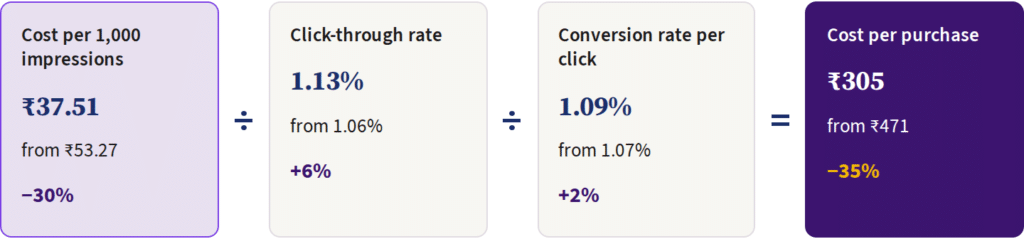
Every cost per purchase on Meta is built from three numbers: what Meta charges to show the ad, how many viewers click, and how many clickers buy. Put the two ads through that chain and only one link moved much.
Almost all of the saving sits in the first link. Meta’s auction does not simply sell impressions to the highest bidder; it favours ads it predicts people will engage with, so an ad that holds attention wins the same placement for less. Once people reached the site, both ads converted at the same rate, so the landing page was not the difference. The video was.
That changes how to read a creative test. Look at cost per 1,000 impressions and click cost before ROAS. If they fall, the creative is earning attention. If only conversion rate moves, look at the page and the offer instead.

The same backpack, two scripts

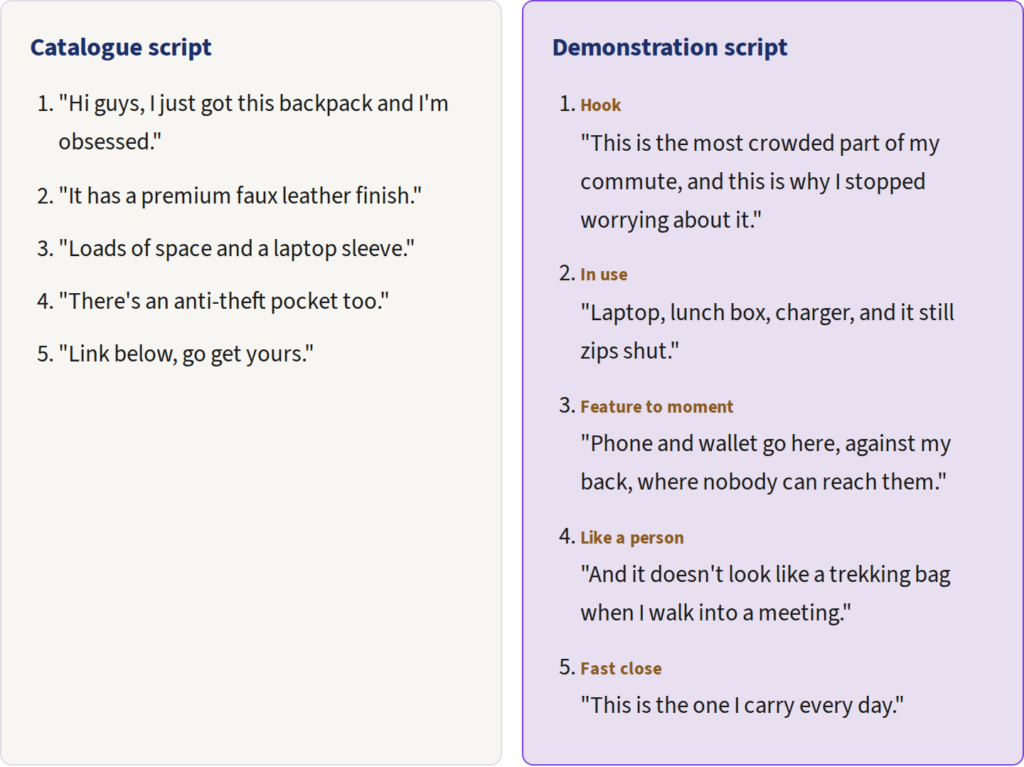
Most UGC briefs produce the script on the left: a person, the product, a list of features. The script on the right shows the product doing its job. We wrote both for this post to show the difference; neither is the ad that ran.
Read them out loud. The first one tells you the bag has an anti-theft pocket. The second shows you the crowd and the hand that cannot reach your phone, which is the reason anyone wants an anti-theft pocket in the first place. Both scripts carry the same features at the same length, and they make completely different ads.

The brief we hand to creators

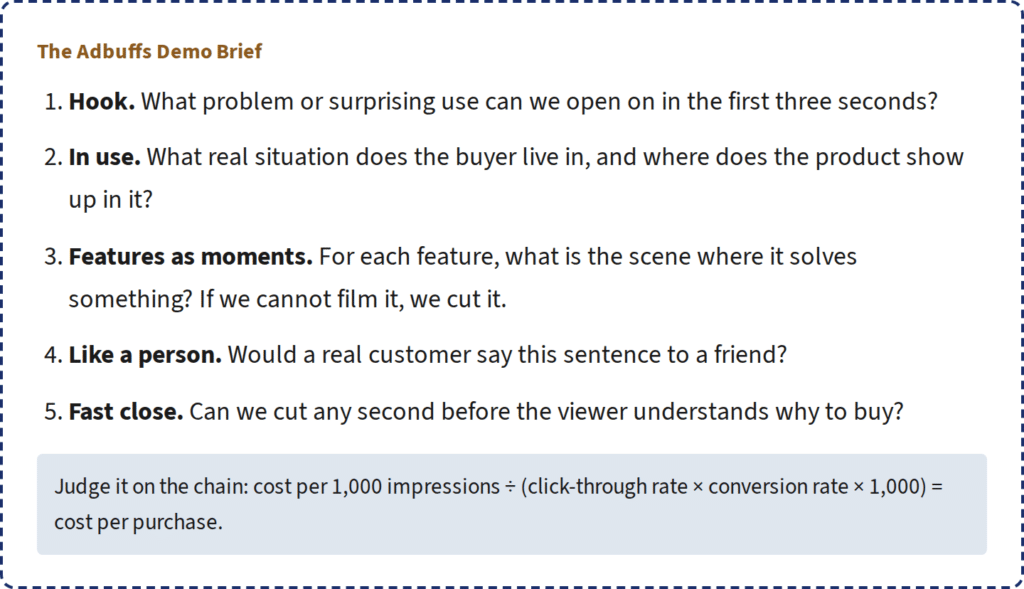
We call this the Adbuffs Demo Brief. It fits on one card, and every line is a question the creator has to answer on camera, not a feature they have to mention.

What we can't claim from this

This is one ad against one other, for a different bag at a different price. The two did not run over identical dates or to matched audiences, so product and timing are part of the gap. ROAS here is Meta’s own 7-day click, 1-day view figure, which also credits some buyers who would have found the brand anyway. We read first-click ROAS beside it, as in Why your Google Ads ROAS falls apart when you scale it. The clean version of this test is two creatives for the same product, with the same budget and dates, in a Meta A/B test.

What the data does support is narrower and more useful. When conversion rate after the click is the same, a gap in cost per sale comes from the ad, and here almost all of it came from how cheaply Meta could show it.

Five things to take into your next brief
  • UGC is a format, not a strategy. Creator-style video wins when it demonstrates the product in use.
  • Write every feature as a scene. If you cannot show a feature working, cut it from the script.
  • Read creative tests down the cost chain: cost per 1,000 impressions, click-through rate, then conversion rate.
  • In this account, a demonstration video cut cost per 1,000 impressions by 30% and cost per purchase from ₹471 to ₹305, with conversion rate unchanged.
  • Scale a winning ad on the same post instead of duplicating it, so its reactions and comments keep building.

Questions people ask us about UGC

Do UGC ads perform better than branded ads on Meta?
Not automatically. A creator-style video that only shows the product and lists features tends to perform like the studio ad it replaced. UGC ads win when they demonstrate the product solving a real problem, with a strong hook and fast pacing.
A hook in the first three seconds, the product shown in a real situation, each feature turned into a scene where it solves something, lines a real customer would actually say, and a quick close. If a feature cannot be shown working, cut it.
Meta’s auction favours ads it predicts people will engage with, not just the highest bid, so an ad that holds attention can win the same placement for less. In one bags account, a demonstration-led video cost 30% less per 1,000 impressions than another video ad.
Break cost per purchase into cost per 1,000 impressions, click-through rate and conversion rate. If the first two improve, the creative is earning attention. If only conversion rate moves, look at the landing page and offer.
Scale the same ad where you can. Reactions, comments and shares build up on one post, and every new viewer sees that social proof. A duplicate starts again with none.

Glossary

UGC (user-generated content) ads
Ads made to look and sound like content from real users or creators, usually filmed on a phone.
An ad that shows the product solving a problem in a real scenario rather than displaying it or listing features.
The Adbuffs five-question creative brief: hook, in use, features as moments, like a person, fast close.
Cost per purchase broken into cost per 1,000 impressions, click-through rate and conversion rate, to show which link a creative changed.
Ad spend divided by impressions, multiplied by 1,000.
Purchases divided by clicks that leave Meta for your site.
In one paragraph
Summary for fast readers
UGC ads work when they demonstrate the product doing a job in someone’s day, not when they put a person beside the product. On an anonymised D2C bags account in India, a demonstration-led creator video returned ROAS of 3.67 at ₹305 per purchase, against 2.84 and ₹471 for another video ad. Broken down, the saving came almost entirely from a 30% lower cost per 1,000 impressions, while conversion rate per click stayed near 1.1% for both. The Adbuffs Demo Brief turns that into five questions for creators: hook, in use, features as moments, like a person and fast close.
Related concepts
Data: one anonymised D2C bags account in India, Meta Ads Manager. Scripts are illustrative and written for this post.

Other Posts that you may Like

9 MIN READ

UGC ads work when they demonstrate the product

True Omnichannel MER is Adbuffs’ measure of real efficiency — net-delivered revenue across D2C, marketplace, and quick-commerce, over fully-loaded spend.

Avatar photo Abhishek Maity, Co-founder, Adbuffs
→
15 MIN READ

Why Meta keeps selling your cheapest products

True Omnichannel MER is Adbuffs’ measure of real efficiency — net-delivered revenue across D2C, marketplace, and quick-commerce, over fully-loaded spend.

Avatar photo Abhishek Maity, Co-founder, Adbuffs
→
Scroll to Top