Volume goals buy the cheapest sale on offer
When a sales campaign is set to maximise the number of conversions, Meta does exactly that. It looks for the people most likely to buy something, anything, at the lowest cost per purchase. In a catalog that runs from, say, ₹1,500 to ₹25,000, the easiest sales are almost always at the bottom of the range, so that is where delivery goes.
This shows up as a plateau that better creative cannot break. Average order value flatlines because the algorithm keeps finding the same kind of buyer. Teams try to push premium products through the same campaigns, the ROAS on those attempts comes back poor, and the high-ticket campaigns get paused. The conclusion everyone draws is that premium does not sell on Meta. The real problem is that nobody asked Meta to sell it. Meta’s delivery follows the instructions and signals you give it very literally, which we also saw when excluding existing buyers made a campaign perform worse.
The account in this post had been through exactly that cycle. Its average order value had flatlined for months, at ₹5,300 in July, and every earlier attempt to scale products above ₹10,000 had been paused for poor returns.
The trap in one line
If your campaign is told to maximise purchases, it will sell you your cheapest products as efficiently as possible, and your premium range will look like it does not work.
Ask for value, not volume
Meta can optimise for the value of a purchase rather than the count. Under the sales objective, the performance goal “maximise value of conversions” tells the algorithm to look for people likely to spend more, using the purchase values your pixel and Conversions API send back. On its own, that setting is not enough. The campaign around it decides whether the algorithm has a clear job.
The Adbuffs framework
The Value Lane
Rule one. Give premium its own lane. Build a separate campaign whose catalog contains only high-ticket products, so the algorithm cannot drift back to cheap items.
Rule two. Ask for value. Set the performance goal to maximise value of conversions, so Meta chases order value rather than order count.
Rule three. Consolidate. One campaign, one ad set, one catalog ad. Every purchase feeds the same learning instead of being split across ad sets.
Rule four. Go broad. Remove interest targeting and keep only basic demographic guardrails, so the algorithm can find premium buyers wherever they are.
Rule five. Judge on value per rupee. Read ROAS and first-click ROAS, not cost per purchase, because a high-ticket sale is supposed to cost more.
Value per rupee (ROAS) = average order value ÷ cost per purchase
Value lane: ₹18,330 ÷ ₹1,977 = 9.27 | Account: ₹5,806 ÷ ₹1,342 = 4.33
The first rule does more work than it looks. Value optimisation inside a mixed catalog still has every cheap product available, and the algorithm can still sell them when they are easier. Filtering the catalog to products above a price floor, ₹10,000 in this case, means every sale the campaign makes is a high-ticket sale. Broad targeting then matters because premium buyers rarely sit in a neat interest category; the purchase-value signal finds them better than an interest list can.
What this looks like on a live account
Below is a D2C jewellery brand we run in India. We launched a single value-optimised campaign with a catalog of products priced above ₹10,000, one ad set, one catalog ad, and targeting set only to women aged 24 and over, starting at ₹6,000 a day.
On these numbers
These are real Meta Ads Manager figures from an account we operate, for 1 August to 15 September 2026, with the brand anonymised and the numbers unadjusted. ROAS here is Meta’s reported purchase ROAS; first-click ROAS comes from first-click attribution in the account’s own reporting.
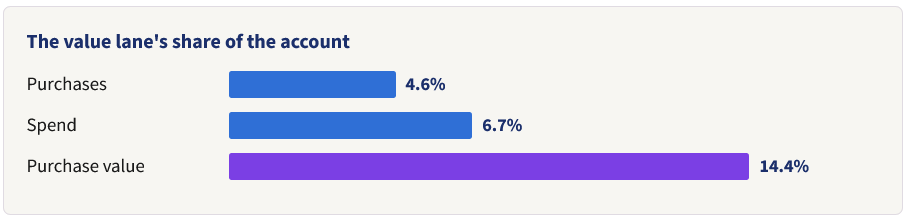
Value lane against the whole account . 1 Aug to 15 Sep 2026
The lane took 6.7% of the account’s spend and produced 14.4% of its purchase value. Its first-click ROAS of 2.55 was higher than any of the account’s other large campaigns and well above the 1.61 overall, so it was not just collecting buyers who already knew the brand. The broad, premium-only catalog also drew attention: click-through rate was 5.94% against 2.19% for the account.
It held up under more money. Over the period, the daily budget went from ₹6,000 to ₹11,500, close to double, and the figures above cover the whole period, including the higher budget. For a range the account had repeatedly paused for poor ROAS, that is the result that matters.
Paying more per sale can be the cheaper choice
Each purchase in the value lane cost ₹1,977, against ₹1,342 across the account, 47% more. A team that judges campaigns on cost per purchase would see that number, decide the campaign was inefficient and cut it. Each of those purchases was also worth ₹18,330 instead of ₹5,806, more than three times as much, so every rupee in the lane returned more than twice what a rupee did elsewhere.
The comparison inside the account makes the point more sharply. The account’s other higher-value prospecting campaign paid almost the same per purchase in the same period, ₹1,986, but averaged ₹8,884 per order and a first-click ROAS of 1.35. The value lane spent the same amount per customer and got orders twice as large.
The lift also showed up at account level. Account average order value rose from ₹5,300 in July to ₹5,806 across August and the first half of September. Take the value lane out and the rest of the account averaged about ₹5,207, slightly below July, so the account’s order-value growth came from the lane.
Be honest about what this is
The lane only sold products above ₹10,000, so its order value was always going to be high. The order-value comparison shows what the lane sells, not that value bidding raised order value on its own. The fair test is returns per rupee, and there the lane led the account. Meta’s reported ROAS also includes buyers who first found the brand elsewhere, which is why we read first-click ROAS beside it. We set out that two-number read in Why your Google Ads ROAS falls apart when you scale it. This is one account over six weeks, 185 purchases in total, during a festive period when jewellery demand rises. To prove what the lane adds, hold it out in a test region and compare, as we describe in The one number that tells you if you’re actually growing.
The terms, stated plainly
Running a value lane on your own account
You need purchase events that carry an order value, a product catalog with prices, and a premium range worth separating.
- Check your value data. Confirm that purchase events reach Meta with the correct order value, through the pixel and the Conversions API. Value optimisation is only as good as the values it learns from.
-
Set a price floor. Pick the price above which a product counts as high-ticket for your brand, and create a product set containing only items above it.
- Build one campaign. Sales objective, performance goal set to maximise value of conversions, one ad set and one catalog ad using that product set.
- Go broad. Remove interest targeting and keep only the demographic guardrails your product genuinely needs, such as gender or a minimum age.
- Give it a real budget. Enough for the campaign to collect purchases every day; a lane starved of budget cannot learn.
-
Judge on returns, not cost per purchase. Compare ROAS and first-click ROAS with the account. Expect cost per purchase to be higher.
-
Scale in steps. Raise the budget gradually while returns hold, as this account did from ₹6,000 to ₹11,500 a day.
-
Prove it with a holdout. Pause the lane in a test region to measure what it adds, not just what it is credited with.




 · Oct 29, 2026