Cheap conversions are often your own customers
A prospecting campaign is set up to reach people who do not know you yet. Meta, though, is paid to find conversions, and nobody converts more cheaply than someone who has already bought. On a brand with a strong repeat habit, the algorithm learns this within weeks. The campaign keeps its name and targeting while its delivery fills up with past customers.
The reporting rewards it. Past customers buy readily and spend more per order, so the campaign posts a lower cost per purchase and a higher ROAS than an honest prospecting campaign ever could. The team sees a strong account and adds budget. Meanwhile the number of first-time buyers barely moves, repeat customers become a larger share of revenue every month, and growth stalls once the existing base is fully harvested.
The account in this post had reached that point. Most of its campaigns were built for cold audiences, yet the algorithm was routing a large share of the budget to people who had already bought, and the brand’s repeat-customer rate had climbed to 55%.
The trap in one line
If your prospecting campaigns post your best ROAS, check who they are reaching, because the cheapest conversions in your account are usually your own customers.
Change what Meta is rewarded for
The obvious fix is to exclude past customers from every prospecting campaign. It can backfire. A hard exclusion removes a large, high-intent pool from delivery and can leave the algorithm struggling, which is what we saw in The Adbuffs First-Click Fix. The better lever is to change what the algorithm counts as success, so it chooses new customers on its own.
Meta’s incremental attribution setting does that. Instead of crediting any purchase that happened within a set window after a click or view, it optimises delivery toward conversions that Meta’s models predict the ad actually caused. A past customer who was going to reorder anyway counts for very little, so the algorithm has less reason to chase them.
The Adbuffs framework
The Acquisition Reset
Rule one. Read the segments. Use Meta’s audience segment breakdown to see what share of spend reaches existing customers, engaged audiences and new audiences.
Rule two. Prune what feeds the base. Pause campaigns and ad sets with a high share of spend on existing customers, low ROAS or duplicated creative.
Rule three. Go broad. Launch new campaigns with broad targeting and only the demographic limits your product needs, so the algorithm has room to find new people.
Rule four. Reattribute. Set the new ad sets to incremental attribution, so Meta is rewarded for conversions its ads caused rather than ones that would have happened anyway.
Rule five. Refuel every week. Without returning buyers to lean on, the algorithm needs new creative to keep learning. Ship fresh hooks and angles weekly.
Existing-customer spend share = spend reaching existing customers ÷ total spend
New customer acquisition cost (NCAC) = total ad spend ÷ new customers
What this looks like on a live account
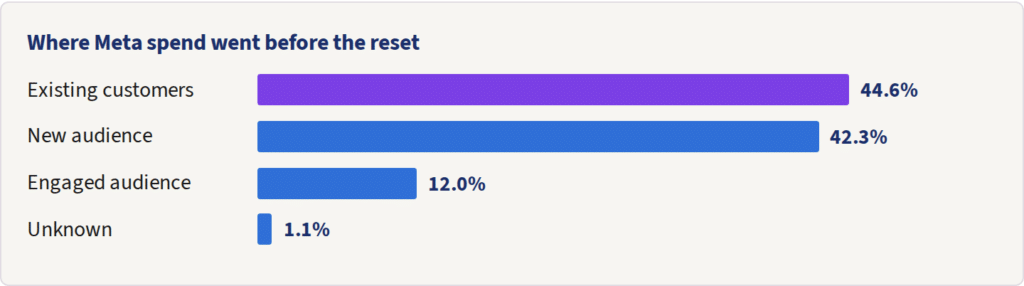
Below is a D2C herbal wellness brand we run in India. Meta’s audience segment report showed where its spend was going before the reset.
On these numbers
These are real figures from an account we operate, with the brand anonymised and the numbers unadjusted. The audience segment figures come from Meta Ads Manager before the reset. New customers come from Shopify, and spend from Meta and Google Ads, for July and August 2026.
Meta spend by audience segment . before the reset
Existing customers took the largest share of spend, 44.6%, more than new audiences, in an account built mostly for prospecting. They also looked like the best audience on every platform metric: the highest ROAS at 2.51, a low cost per purchase and the largest orders, which is the whole illusion in one table. New audiences, the people the campaigns were built to reach, showed the weakest ROAS of the three main segments at 1.61, so any optimisation that chased ROAS would have pushed spend further toward the existing base.
We paused the ad sets with a high share of spend on existing customers, low ROAS or duplicated creative, and launched broad campaigns targeting women over 24. The new ad sets ran on incremental attribution, with new creative carrying fresh hooks and problem-solution angles shipped every week. The switch made scaling harder at first, because the algorithm lost its easy repeat sales, and the weekly creative volume was what stabilised ROAS enough to keep raising budget.
New customers became cheaper, not just more numerous
Shopify shows the result. In August, the account added 4,603 new customers against 1,998 in July, an increase of 2,605, or 130%. Returning customers held almost level, up 3%, so the existing base kept buying while the new-customer engine restarted. Returning buyers went from roughly three in five customers in July to about two in five in August.
New customer acquisition cost . July against August 2026
Spend rose 53% and new customers rose 130%, so each new customer cost a third less: ₹595 against ₹895. That is the number that matters after a reset like this. Platform ROAS stops crediting easy repeat sales after a reset like this, so it can look flat or worse even while the business is acquiring customers more cheaply than before. Judge the change on new customers, counted in your store rather than in Ads Manager.
Be honest about what this is
Spend rose 53% between the two months, and Google Ads spend more than doubled, so some of the new customers came from more budget and from Google rather than from the Meta reset alone. The fall in cost per new customer is the stronger signal, because more budget on its own usually makes each customer more expensive, not less. Shopify counts every first-time buyer, whatever brought them in, and this is one month against the one before it. Meta’s incremental attribution is itself a model of what its ads caused, not a controlled test. To prove what the reset adds, hold out a region and compare, as we describe in The one number that tells you if you’re actually growing.
The terms, stated plainly
Running the reset on your own account
You need Meta’s audience segments set up with your customer list, a store that reports new and returning customers, and the capacity to produce new creative every week.
- Set up audience segments. In Meta’s advertiser settings, define your existing customers and engaged audience, so reporting can split results by segment.
- Read the split. Break down your prospecting campaigns by audience segment and note the share of spend reaching existing customers.
- Prune. Pause ad sets with a high existing-customer share, low ROAS or duplicated creative. Leave dedicated retention campaigns alone; they are meant to reach past buyers.
- Go broad. Launch new prospecting campaigns with broad targeting and only the demographic limits your product needs.
- Switch to incremental attribution. Set it on the new ad sets at launch. You cannot change the attribution model once the campaign is live, so decide before you publish.
- Ship creative weekly. Expect returns to dip at first. A steady flow of new hooks and angles gives the algorithm the material it needs to find new buyers.
- Judge on new customers. Track new customers and new customer acquisition cost from your store every week, not platform ROAS.
- Prove it with a holdout. Pause the new setup in a test region to measure what it adds.





 · Oct 29, 2026