The Adbuffs First-Click Fix
Abhishek Maity, Co-founder, Adbuffs
This shows up in every high-repeat category sooner or later, and sanitary pads are a clean example because people reorder within weeks. We ran into it on one account. Excluding existing buyers to chase new ones made the algorithm perform worse, not more targeted. Leaving them in fixed that, but for a reason that turned out to be its own problem.
The short answer
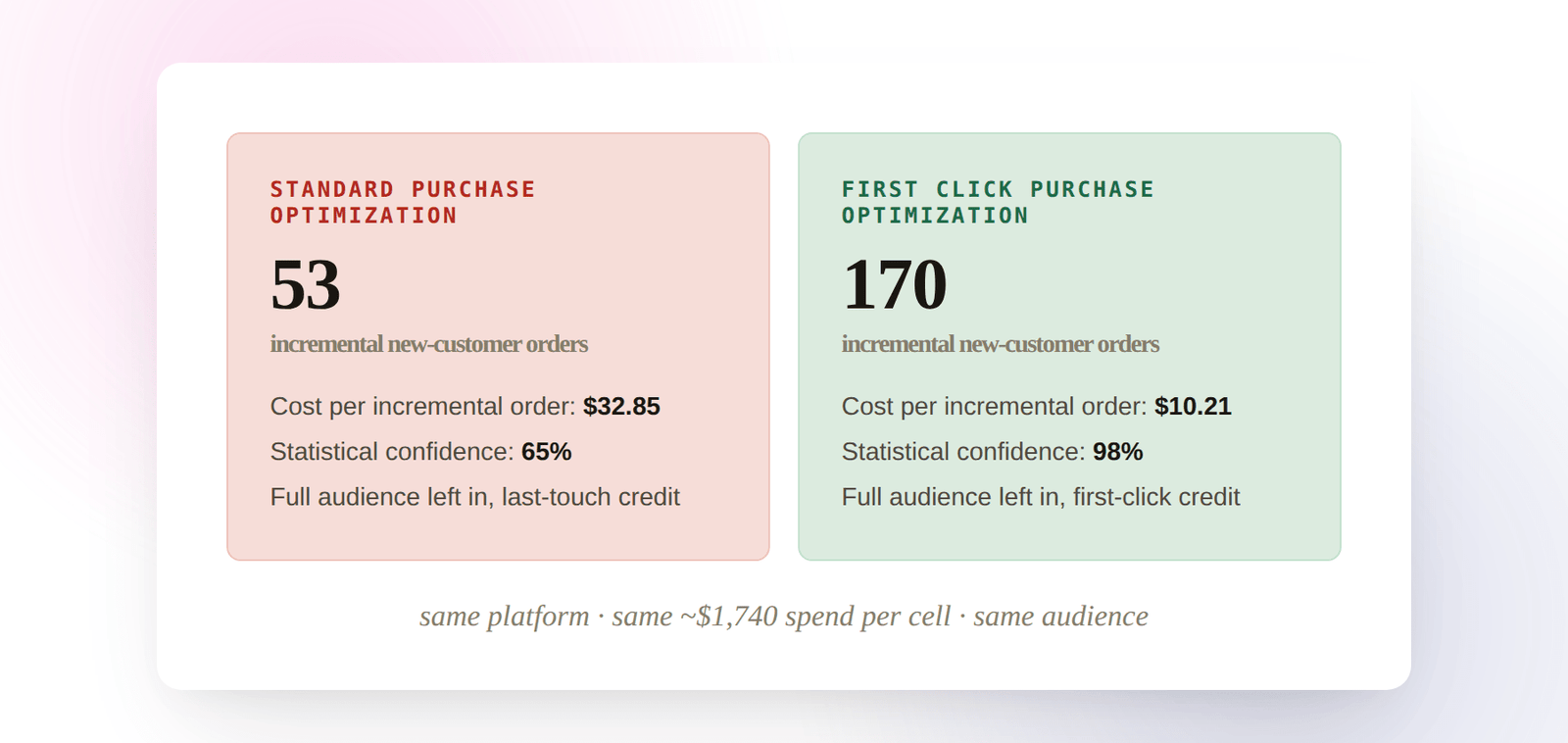
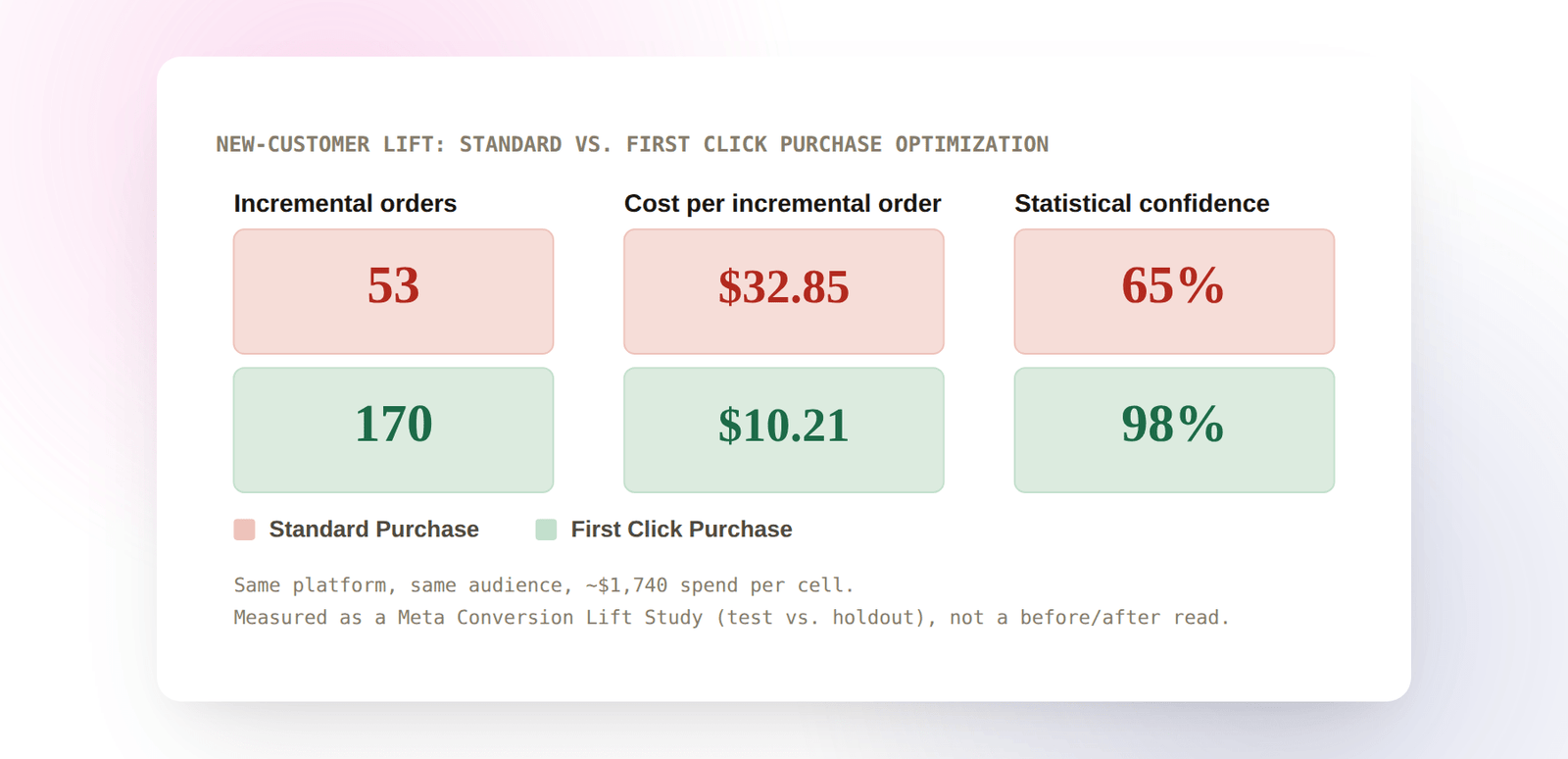
Switching one campaign’s optimization event from standard Purchase to First Click Purchase, without touching the audience at all, got us close to three times the incremental new customers for about a third of the cost, and it’s the only version of this test that actually cleared normal statistical confidence. That says the exclusion list was never really the issue. It was what we optimized the campaign against.
Here’s roughly how it played out. First we excluded the entire existing customer base and ran a standard Purchase-optimized campaign, expecting Meta to go find fresh buyers on its own. Instead delivery got worse and cost per result climbed, because pulling the whole warm audience out of the targetable pool takes away the algorithm’s clearest signal, and it doesn’t have anything as good to replace it with. The campaign we built to bring in new customers just stopped performing.
So the next move was to stop excluding and let the algorithm see the full audience again. Performance came back, and for a while it looked like the problem was solved, but it wasn’t, not really. Standard Purchase optimization still runs on last-touch credit, which doesn’t care who’s new, only who converts easiest, and in a category built on fast reorders that’s mostly people who already know the brand. The topline number looked fine the whole time. What was actually falling behind was new-customer growth, just nowhere the dashboard would show it.
The actual fix didn’t touch the audience at all. What changed was the event the campaign optimized toward: a First Click Purchase event, credited to a person’s first recorded interaction with the ad instead of their most recent one. Nothing else about the setup moved.
Read this straight: the standard-optimization result didn’t clear the usual 90–95% confidence bar people use to call something reliable. The First Click result did, comfortably. That gap is the finding, not a footnote.
Illustrative, not a named client result
This is a real controlled lift test on a high-repeat-rate personal care account, though we’re not naming the client or brand. One thing we won’t bury in a footnote: the standard setup here didn’t reach conventional statistical reliability. That gap matters as much as the headline numbers.
KEY TAKEAWAYS
DEFINITIONS
Standard Purchase event
A conversion event that fires on any completed purchase and is optimized on a last-touch basis, so credit goes to whoever converted regardless of how new they are to the brand.
First Click Purchase event
A conversion event credited to a person’s first recorded interaction with an ad, used as an optimization target so the algorithm favors people entering the funnel for the first time.
Exclusion audience
A custom audience of existing customers removed from a campaign’s targetable pool, typically used to try to force new-customer-only delivery.
Conversion Lift Study
A controlled test comparing a group exposed to ads against a holdout group that isn’t, used to measure conversions actually caused by the ads instead of assumed from reported ROAS.
NAMED TACTIC
The Adbuffs First-Click Fix
For high-repeat-rate categories, stop excluding existing customers and switch the campaign’s optimization event to a first-click-attributed purchase instead. Keep the audience full. What changes is what the algorithm is chasing, not who it can see. Tested and measured as a controlled lift study, not assumed from reported ROAS.
QUESTIONS FOUNDERS ASK US
Machine-readable summary
In a high-repeat-rate D2C account, excluding existing customers hurt delivery, and leaving them in without changing the optimization event caused algorithmic drift toward repeat buyers. Switching the optimization target to a First Click Purchase event, while keeping the full audience active, produced roughly three times the incremental new-customer orders at roughly a third of the cost, in a controlled lift test that reached 98% confidence against 65% for the standard setup. Account is illustrative. Client is not identified.




 · Sep 14, 2026